Swamiji’s Sandesh – “Bhagwan jis haal mein rakhey , usmey khush raho…”

PHOTO-2020-06-19-20-00-09

Swamiji says …

“Pleasure and pain; happiness and grief – are two sides of the same coin – and, if we assume ourselves to be a coin, we’ll undoubtedly find ourselves wearing two completely varying visages on both surfaces – one – lively, cherubic and happy; and the other, bearing signs of worry and sadness on it. Ironically, identical is the demeanour that is worn by us; and similar are the emotions displayed by each one of us – in real life – during the constantly changing scenarios that life surprises or shocks us with ; fun times are interspersed with challenges; laughter could be interrupted abruptly by sudden sobs; a dream run period could come to a screeching halt as a nightmarish phase encloses its firm grip on us… but it is how we receive, respond and react to the minute to minute changes in life that clearly defines us, makes us what we are, and that is what matters the most, at the end of the day!”

“An urgent need to understand God’s Divine plan, His Grace and Will – ‘Jo vidhaata ne humare bhaagya mein likha hai woh hi hoga – Jo sukh hummey bhogna hai, woh hum bhogenge, aur joh dukh humare hissey aana hai woh aayega!‘ – will most certainly make us live life with a more realistic and mature approach. Do we handle the ups and downs of life with the same poise and grace, is a question that needs an immediate answer? Are days of difficulty and duress accepted with the same sense of equanimity with which days overflowing with happiness are welcomed? Each day differs and thus, do we too behave differently! Honey-sugar welcome for happiness, and a bitter-shock treatment for unhappiness!”

“Remember, life can neither be smooth and placid; nor turbulent and disturbed forever. Sharp, rough edges will scrape us for sure. But man seems to forget this, and tries to study it from the point of view best suited to him- one that is of comfort and ease. He rejoices and celebrates in moments of triumph and glory and attributes the success achieved by him to the sheer dint of hard work that had been put in by him, and gains a sense of confidence that with God’s blessings, his life could remain devoid of problems and worries. So grateful is he to God that he chants his name repeatedly in gratitude ; remembers to thank Him profusely for enabling him to achieve his dream and for blessing him in abundance with everything that he could have ever dreamt of! Nothing could give God greater happiness than to see His child worship Him with devotion regularly;  and He continues to shower His blessings on him. The recipient’s faith in God’s greatness increases by leaps and bounds.”

” But the point in question is whether the same individual will look upon God with the same reverence and faith the moment there is a drop in his fortune! Will a changing tide portending hardships, transform him into a completely ‘different’ human being? Happiness and unhappiness, evoke vibes that are startlingly poles apart. In retrospection, it appears that man is engineered to behave in this way. Unforgettable moments of ‘sukh’ – that fit perfectly into our lives like a dream- where wishful thinking, develops wings of fulfilment and takes a concrete shape, reinforces his faith in God. His respectful attitude for God simply states- ‘I am God’s favourite child. Nothing can ever go wrong for me!‘ But do we show the same grace, dignity and faith when faced with challenging situations. Does the joy of experiencing God’s Grace remain intact, or is it replaced by frissons of anxiety on being wrought with worries… on being confronted with ‘dukh’? We alone can answer this question.”

” What is our reaction when the going gets tough? More often than not, we see man behave in a  bewildering manner before our eyes. He becomes morose, questions God, begins the blame game, adds to his woes and agony by refusing to accept the unexpected. He then directs all his negative energies on God, holds Him accountable for his pitiable state, makes Him a target of his wrath and refuses to worship Him. Does God warrant a hostile, accusatory treatment of this kind? He fails to remember – ‘Ussey abhi aur tapna hai… Jeevan neeras ho jata hai jab usmein koi mushkil ya takleef nahi hoti hai!” He forgets the countless times when God had stood by him and saved him in the nick of time from adversities. No, he wouldn’t remember all of that, would he? After all our memory span is very short.”

“We have created this division between happiness and unhappiness as we refuse to understand that come what may, and how much we try, we cannot wish away the ever – changing facets of life. Off and on, it looks at us with hopeful eyes, accompanied with a broad smile, and, at times, sizes us up with a look of worry in its eyes; without any trace of a smile… but our duty is to accept whatever comes our way, to be in an eternal state of gratitude to God to have blessed us with life itself- and live life on the terms and conditions set and framed by Him, as they would be best suited for us … ‘Aur Ishwar ko har paristhiti mein yaad karna chahiye !”
Truth of Life – Part 4

In continuation to Truth of Life – Part 1, Truth of Life – Part 2 & Truth of Life – Part 3

img_0790

Moving on to the 3rd and most critical component viz. “Self”, “Atma” or the “Soul”. What are its properties and how can we know it?

Our body, sense organs, mind, ego, this world of matter which seems real to us is “not self” but is “Maya”. “Self” or “Atma” is what is beyond Maya. Atma is formless and has no shape. It does not die. It is not a body which keeps changing every minute. It is not a mind either which is affected by happiness and miseries of life. It is above all this, witness of different states of consciousness. It is beyond the limitations of our body and functions. It is that by which we experience waking, dreaming and deep sleep states. It is that by which our body and all our sense organs function (we cannot see it with our eyes but it is by which our eyes are able to see). It is pure existence and changeless. It is neither born nor does it die or perish. It is eternal, Nitya.

We have a gross body and a subtle body. The Atma works the subtle body and through subtle body it works the gross body. Atma is separate from the body and the mind. Atma is always blissful. We think that the pleasure we get is in the object or the fulfilment of our desires, but it is not so. Actually, our mind is always in flux. It is never in a state of rest. When our desire is fulfilled, the disturbance of our mind ceases for some-time. At that moment we see the real nature of our soul, the blissful nature and feel happy. If we can keep our mind at peace, we can always remain in contact with our self, the Atma and in a state of bliss.

Only by concentration can we know our soul. As we cannot the see the bottom of the lake till the waves are active, in the same way we cannot see the real nature of our soul till the thought waves are present in the mind. When we are able to subside all the waves, we will find that the soul is immortal. It can never die. Every person is born with the impression of all the lives he has lived. He gains experience in life after life and slowly moves towards perfection. When “self’ is realised, one gets liberated from all the bondages. This state is called “Kaivalya”, a state of constant bliss.

Now, if that is so then why can’t we find happiness in this world and why is there so much misery?

Just imagine, if there were no misery on earth, no one will strive to be free from the cycle of life and death. In fact, this earth, with all the misery, is the place of action, the “Karma Bhumi”. Everyone who wants to attain the ultimate goal of liberation, i.e. self-realisation, has to come to this earth and with devotion, meditation and Bhakti, reach that State. The true happiness is achieved only through self-realisation. The nature of self is unending bliss. We remain far from happiness in this life till we search for happiness outside our self. That is in sense pleasures through our body, in emotions and rational thrills through our mind and intellect.

Therefore, know yourself, know your Atma and remain happy forever…..to achieve this, the secret is “meditation” which has also been made simple by Swamiji in the earlier section available in the gallery.

All about meditation – Part 1 : What is mediation? Why is it necessary? How to master the art?

All about meditation – Part 2

All about meditation – Part 3 : How long should one meditate & How do you know that you are progressing?

All about meditation – Part 4 : Why do we at all need to meditate? So…..finally, Meditation is a “must”!

Truth of Life – Part 3

In continuation to – Truth of Life – Part 2 & Truth of Life – Part 1

img_0784

Going forward, Let’s understand what Human Mechanism is…..

Each human being can be broadly classified into two categories – The Matter and The Spirit. The body, mind and intellect are formed of matter and are insentient (Lifeless). The Spirit is the life in the human being. The spirit is also called the “self” or the “ätma”. It is only the body, mind and intellect that becomes restless. The Atma is ever blissful and in peace. One can relate this to the three components mentioned in Part 2.

truth-of-life-part-3

The body or physical body also called as “Sthula Sharira” is formed of five gross elements or materials viz. Akasa, Vayu, Teja, Apas, Prithvi (Sky, air, fire, water and earth). This body is also called the gross body or the outer most body of the man. The five elements combine to make the body dependant on the actions of one’s past karmas. It has five organs of perception and five organs of action. The organs of perception being (as everyone knows) eyes, ears, nose, skin and tongue which get stimuli from the external world and send it to the mind for comprehension.

The mind or the Intellect then discriminates and sends the required response to the organs of action (being speech. Hands, legs, arms and genitals). A person who does not use his intellect acts impulsively and does not take correct actions. The person feels happiness and sorrow in his lifetime through his physical body alone. Through his body only does he enjoy all the sensual pleasures he feels resulting due to the contact of objects which are outside his body. This physical body has certain essential properties – it is born, it grows, it suffers from diseases and it perishes. It changes every second. We are not what we are a second earlier.

The subtle body or the fine body or “Sukshma Sharira” (defined as memory or intellect above) contains the organs viz. the mind, manas, the intellect (buddhi) and the ego (Ahamkara). Organs (Indriyan) means the centres in the brain. Each sense action has a center in the mind. Those who cannot hear have ears (the instruments of hearing) but have damaged center of hearing in the brain. That is why we cannot hear someone calling us when our mind is engaged in something else and does not react to the call. When the mind reacts do we connect to the sound. The actions and thoughts through this fine body or Sukshma Sharira (also called as Karan Sharira) have a direct impact on the soul/Atma/Ruh. At the time of death, the Ruh/Atma separates from the other two body forms and takes a new form based on past karmas.

More about ‘Soul’ in our next post…

Truth of Life – Part 2

In continuation to – Truth of Life – Part 1

img_0779

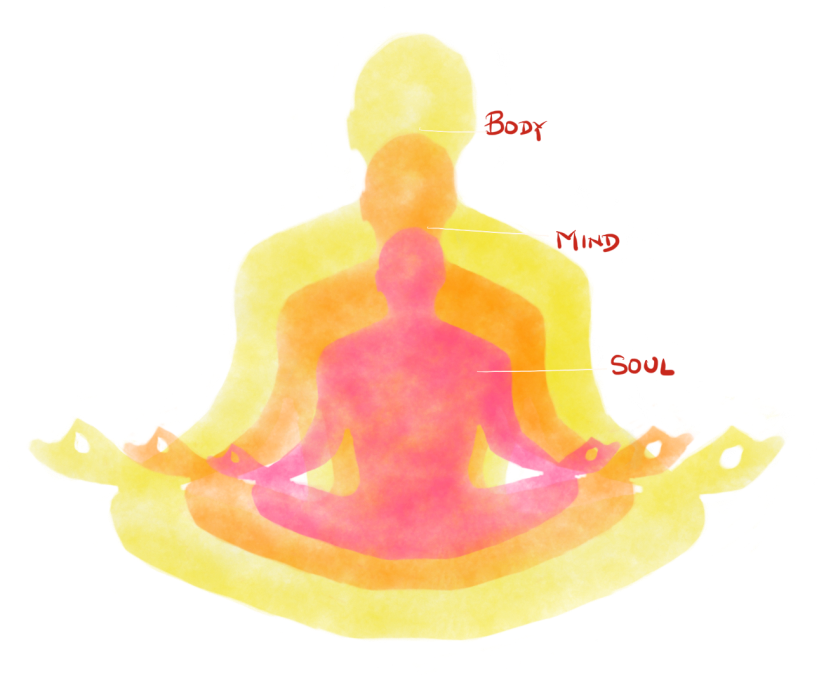
Swamiji Says, we are the “Soul” or “Ätman”. Swamiji explains further and tells that our existence has primarily three components viz. External Body, Memory, & Soul. What we can feel and experience are ‘the Body’ and ‘the Memory’ but it’s actually ‘the Soul’ that we are. Our Soul is the purest form of self and the other two are just the temporary covers the soul embraces to come in this world till it is liberated. All these ages, the unliberated souls have not been able to identify their true selves and hence have to wander in this universe through the cycle of birth and death.

Is our birth the “Beginning” and death “The End”?

No!….its only the body that is born and perishes, the soul or Atman, does not die. We neither have a beginning nor an end. We remain in the universe in some form or the other. A person who attains self-realisation does not come back and gets merged in the Absolute. That’s when the soul is liberated, freed from the shackles of Karma and merges with God.

If not, then why are we required to be born again and again in this world?

We are made in the image of God. But due to our free will and our actions in life after life, we have forgotten the true nature of our self which is the soul (Atman). When we know God and realise pure and perfect nature of our soul, the difference between God and us gets reduced. That is in fact the goal of life and we can achieve that only by working through our body. A person who is wicked today and indulges in wrong doings, will also come to the right path, may be when he gets a jolt in his life in a certain birth. And…till the time we achieve our goal of perfection, we keep coming in this world again and again.

But, is there really some God?

Of course yes! There is God. You may call it by different names. Those who do not believe in it call it nature or an intelligent force working in this universe. Its just like asking if anyone of us have a father? The proof is our existence in this world.

What is the secret of life and death? What happens when a person is dead?

It seems that birth is the beginning of life and death the end. Yet it is difficult to distinguish one from the other, just like the evening time which seems to be the end of the day but is the beginning of the night. Man does not know what he was before this life, whether he had any existence and in which form, from where he has come and for what purpose, where he will go when the end of his life comes. He is in ignorance in life as well as death. Life is in existence not in the body alone. When we die, the components of our body mingle with the five tatwas and the real self viz. the soul is released. This soul takes another body, depending upon the past actions of life. In fact nothing gets destroyed in nature and only the form changes. When the soul separates from the body at the time of death, it becomes a separate entity. The actual nature of soul is pure and bliss. It seems miserable and impure because of illusions of this materialistic world. When by meditation and self-realisation, the real soul is understood, eternal rest or Moksha is achieved. The journey of life continues till the purpose of existence is not attained. Till all the desires are not destroyed, the soul has to come again and again in new forms in this world to fulfil the left over desires and results of karma.

Where is God? Why can’t we see him?

God is everywhere and in everything we see in this Universe. You can compare him with a seed from which a tree has grown. What we can see is the bark of the tree, the leaves, the flowers and the fruits. We cannot see the seed which is hidden from our eyes. But it does not mean that the seed is not there. This Universe has been created by Him; which we can see. One God has manifested Himself into many forms. Leaves, fruits, branches of the tree, everything is a manifestation of the seed. We cannot see Him because we want to see Him with our limited five senses. We cannot know Him because we want to know Him by our limited intelligence and intellect. We work with our conscious mind and reason in our limited sphere. But beyond the conscious mind, we have an unconscious and a superconscious mind. Superconscious state comes only when we attain Samadhi. All the knowledge beyond our reasons and our five senses come to us when we are in this Superconscious state. It is then when we experience God and know many answers to other important facts. We start towards the path of God only when we go beyond our reasoning power. Those who wish to see Him or experience Him without making any effort are trying to see the picture on a TV screen without putting up any Antenna.

flower1

Keep reading for more, or write back for any doubts you have, for any questions you need to be answered, because we all have questions that we need answers for!