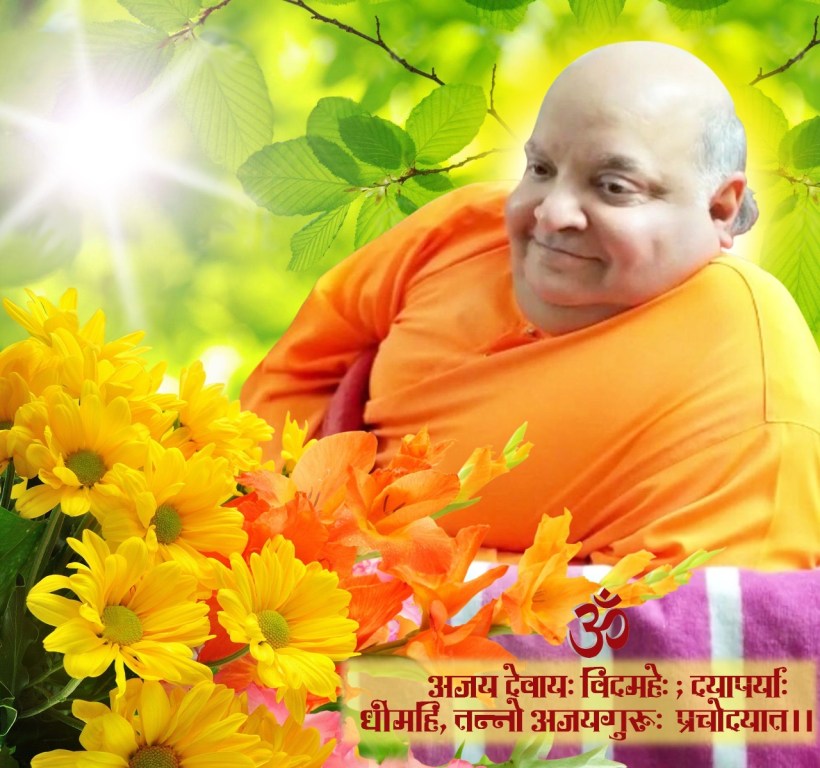
‘Aadhyatmik ‘guru’ aur ‘bhakt’ ‘

Swamiji says ….

” Devotees play a very important role in taking a spiritual guru’s name to greater heights…”
“‘Aadhyatmik’ guru ka naam, apne ‘bhakton’ ke diye huey maan-sammaan dwaara jaana jaata hai …”

“Guru Brahma, Guru Vishnu, Guru Devo Maheshwara,
Guru saakshaat para Brahma, tasmay shri guruve namah …”
” ‘Anant anaadi kaal se sant, rishi, muniyon ke aadar mein, unki prashansa mein, unke maan – sammann mein, yeh shabd, dharti par goonjey hain, aur insaan ne unnhey alag, alag naam se sambhodit kiya hai.’ Some devotees addressed them as ‘Guruji’, some as ‘Swamiji’, and some even referred to them as ‘Bhagwaan’!”

“The rich, fertile soil of our country bears testimony to the indelible, divine footprints of some of the greatest sages and saints, who had crisscrossed the vast area of Mother Earth, over the ages, imparting every grain of knowledge that had been inherited by them, in the form of the most valuable spiritual legacy, from their enlightened ‘gurus’. It is rightly said – ‘Guru bin gyan nahi ‘ and a few blessed fortunate souls who had enjoyed the rare privilege of being handpicked by the greatest ‘gurus’ of a particular time period – had ecstatically soaked in every syllable of spiritual knowledge that was enunciated to them personally by their ‘guru’; had also shared the same holy space in which their ‘guru’ – the representative of God – resided; had inhaled the same air that was breathed by their most learned ‘gurus’ and personally experienced the spiritual aura of their ‘Teachers’. These blessed souls had understood the core message of the ‘guru mantra’ that was whispered in their ear by their revered and esteemed ‘guru’ and on realizing the wealth of True Knowledge -‘gyan’ ka anmol khazaana joh unhe apne ‘guruji’ se praapt hua tha ‘ – that had been absorbed by them, awoke to the true purpose of their life – To spread the message of their ‘gurus’ far and wide ; as far as the eye could see.”

“These noble, selfless souls had willingly taken upon themselves the sacred duty of introducing the simple, relatable and practical teachings of their ‘gurus’ to all those
who were not as privileged as them, and left no stone unturned in spreading the name of their ‘guru’ far and wide. ‘Guru’ was God for them and they immersed themselves completely in serving Him, oblivious to their own physical or material needs; set aflame by the burning desire to illuminate and enlighten the entire world with the light of ‘guru gyan’ aur ‘guru’ ke gunn bhajney mein, apne aap ko bhula dete thay !”

” ‘Jis tarah ‘Bhagwan’ bin ‘bhakt’ nahi, ussi tarah ‘ ‘bhakt’ bin ‘Bhagwaan’ nahi!’
The name of the ‘guru’, ‘Swami’ or ‘Bhagwaan’ is remembered for eternity and transcends both time and space. But do we ever try to go beyond the greatness of the ‘guru’, and reflect as to who made His Name, His Grace, His merciful and forgiving temperament known to the world? Do we give credit to those who truly deserve it? Are we grateful to His ‘shishya’ – devotees – for emphasizing that their ‘guru’s’ knowledge is incomparable; His love and compassion, unsurpassable; and His inspirational teachings as soul- enlightening !”

“ ‘Bhakt ke dwaara hee ‘Bhagwaan’ aur ‘Guru’ jaane jaatey hain!’
Time has been a silent witness to the tireless effort, selfless service, total surrender, complete involvement, devotion, and dedication of devotees that has made it possible for future generations to be acquainted with the worthiness and Godliness of their ‘guru’. Can the Earth resound with the reverberations of the name of a ‘guru’ unless His devotees have sung His name with a pure and devout heart, lovingly weaving lyrics, praising His lofty ideals and teachings? It has always been divine love, unswerving – but not blind faith, that the devoted, loyal ‘bhakts’ nurse for their Gurus – “’jinhone apne ‘guru ‘ ka naam aagey badhaya tha’.”

“Devotees – pure hearted and pious, untouched by fatigue and tiredness, derive divine pleasure in chanting, worshipping and offering prayers to God and Guru…’ Agar bhakt na pooje, toh Bhagwaan aur ‘guru’ ka naam sansaar kaise jaanta!’ Thus, the pivotal role that has been played by devotees should neither be underplayed nor ignored. ‘ ‘Bhakt’ aur ‘shishya’ ka darzaa bhi bahut ooncha hota hai! ‘ The pure, divine, uplifting love that develops between a ‘guru’ and His obedient ‘shishya’, between God and His ardent ‘bhakt’ – ties them, connects them with an inseparable bond – where the ‘shishya’ does not tire of serving his Guru, as the seeds of knowledge that were sown in him, by his ‘guru’, start blossoming and enable him to experience spiritual ecstasy. The devoted ‘bhakt’ rejoices in the hours spent in the divine aura of his ‘ishta dev’, repeats his chosen deity’s name with utmost sincerity and reverence, and realizes that the repetition of God’s name is purifying him as his soul is being cleansed in the process.
“’Bhakt’ ke dwaara hee ‘Bhagwaan’ aur ‘ guru’ jaane jaatey hain, pehchaane jaate hain!”

“ ‘Sant’ hee ‘sant’ nahi hota, ‘guru’ hee ‘guru’ nahi hota , agar ‘bhakt’ nahi hotey… ‘Bhakt’ bahut achche hotey hain !’ – and if it was not for the determination and focus with which such faithful devotees had channelled the divine love and faith that they bore for their ‘guru’, energetically and enthusiastically; it would not have been possible for the world to know about their ‘guru’ and His Grace.”

‘Jeehva aur jeevan’

Swamiji says …

” Speak in a manner that doesn’t hurt anyone …”

” Insaan ko apni ‘jeehva’ par niyantran rakhna chahiye … Achchi vaani bolo.. “

” ‘It’s a boy !’ ‘It’s a girl !’ ‘What a beautiful child ! ‘ ‘ Kitni sundar hai!’ Our birth is welcomed by ‘sounds’ of reactions from people around us – doctors, nurses and all those who love us. As newly borns, we might have wondered about the unfamiliar sounds that were made by some strange looking creatures around us, but gradually our ears grew accustomed to words of endearment, love, care and concern – which we tried to emulate shortly by saying ‘da da’, ‘ma ma’; by making some musical sounds by clicking our tongue, and gurgling delightedly, on succeeding in doing so. We must have realized right from our teething years, about the powerful effect that words said by us had on others, as they magically and invariably, evoked a response from people around us, be it in the form of a smile, a hug or a spank; and, then, as we grew up, we starting speaking, talking, conversing.”

” It is the tongue that had made us aware of the ‘taste’ of various food items that were introduced to us, and how we had hungrily lapped up everything sweet that was placed on our tongue, but outrightly rejected anything and everything, that was sour and bitter. We were able to straightaway detect the difference between the two – sweet and bitter – at that tender young age itself- opted for the sweet dishes with great relish, and turned away from anything bitter in disgust. We must remember that the same rule is applicable when it comes to voicing words with our tongue. Is our manner of speaking and communicating with others sweet, cordial and polite or is it bitter, impolite and nasty?”

” The question arises then – But, do we remember? Do we speak sweetly and softly and follow a certain decorum while conversing with others? ‘Kya hum achchi vaani mein doosron se baat kartein hain? Jeevan ko sundar bannane ke liye apni ‘jeehva’ pe niyantran karna chahiye.” How many of us remember … ‘ ‘Jeehva’ agar niyantran mein rahegi aur tum achcha bologey, toh jeevan apne aap sunder bann jata hai.” Words, when spoken softly and used appropriately by us, have the power to attract people of all ages towards us and we can win them over with our caring, loving and considerate words. People, known and unknown, will gravitate towards us of their own accord, as the words said by us could give them comfort, pleasure and motivation. More than others, it is we who gain and benefit in the long run, as speaking in a becoming manner becomes our habit and we cultivate life long relationships – and our family and friends are ever willing to help and stand by us, through thick and thin.”

“Yet, the same tongue is capable of eliciting a drastically different response from others – the moment it disbelieves in keeping an even-tempered attitude, and instead, chooses to use itself as a whip, to lash out verbally, at people. At times, a peculiar notion of being totally independent, drives a tongue to work at its free will, and makes it feel that its sole purpose is to cane and hurt family members, friends and others, with its knife edged sharpness, and thus uses itself liberally
to humiliate, insult and hurt them. The sadistic pleasure once tasted by it, on seeing another person writhe in pain, emotionally, on receiving words that can strip him of his dignity, instigates it to repeat and replay these words over and over again, on others, just for the sake of seeing their bewildered, nonplussed, shocked reaction. Would anyone want to be anywhere close to a person with a tongue as waspish and acerbic as this? Would anyone want to befriend a person…’ joh itna galat bolta hai …’ After all, nobody wants to be used as a target for darts laced with venom and vitriol. An individual who speaks in a manner as distasteful and unwarranted as this, can be rest assured of living an isolated life, devoid of any smiling faces and helpful hands around him. Remember, words spoken with good intent – appreciating someone, guiding, or advising others – are more valuable than wealth and gold.”

“Use words carefully , judiciously. Be aware of all that is said by you.Think before you speak, as you can never take back words, once they’ve been said by you. Be clear and straightforward as honest words don’t lie. Words said carelessly by you can cause a wound so deep in the other person’s heart, that although he might ‘forgive’ you for what had been said by you, he may never ‘forget’ the hurt and grief that had been caused by you. Words said by you should have the power to touch the soul of a person, to heal him, to cure him and to inspire him. A person with a spiritual bent of mind spends most of his time repeating the name of God over and over again, reciting the ‘guru mantra’ and chanting verses from the scriptures … ‘Aissey insaan ke munnh se, phool jhadte hain ! “

‘Santushti’

Swamiji says…

” Mujhe yeh chahiye! Mujhe woh chahiye! Mujhe aurr chahiye! Woh cheez mil jaati, toh mujhe santushti ho jaati! I want this! I want that!” These words sound very familiar. Don’t they? Each one of us is surely able to vividly recall the excitement that we had experienced – as infants – on seeing the colourful little toys that were used as a bait by our parents to distract us, to stop us from crying; and how we used to, through our tears, look astutely, with great interest at those fascinating objects – stop crying and throw our tiny arms in the air to get a hold of that toy. And then again would resume crying, disconsolately, until we had acquired possession of that toy. We had to possess it and let it be known to one and all that we possessed it. The game of contentment and discontentment had thus begun. One could argue, but it was right from then that these traits that we possessd had come to the fore !”

“This craving, longing, constant pining to own, possess and hoard more and more, festers within all of us. It is up to us to either let this gross ‘desire’ grow within us, gnaw at our peace of mind, or,get rid of it for once and for all, by simply saying ‘No! I am content and happy with what I have. I don’t need any more of anything !’ Words that are so rare to hear in today’s materialistic world. A few fortunate, sensible ones are able to draw a line and reach a conclusion – ‘I am happy with what I have, and I have enough of everything. No more!’ “

“The ability to say – ‘I have everything that I need and ever wanted, and don’t desire anything more!’ – needs a strong will and courage and, believe me when I say, that it is possible for us to say – ‘No!’ and to understand that the cause of our unhappiness is the desire to possess, acquire and own more – and it is this desire that tempts us, lures us towards itself – and we fail to see that we are wasting our precious lives by procuring inanimate, lifeless objects, senselessly. The irony is that instead of considering our lives as priceless ; we value things to be priceless.”

“Try to visualize the physical and mental state of a person who is satisfied and content …’ joh apne jeevan ke haalat aur paristhitiyon se santushtha hai…” Life is perfect for him. He couldn’t have asked for anything more and is in a constant state of gratefulness to God for giving him all that he ever needed, without him asking God for anything. He is more than satisfied with all that he has and has nothing to complain about. His mind is clear, free of the clutter of the never-ending profit and loss analysis of life. He is in a state of bliss, at peace with himself, and also with others …’Aise insaan ko mann ki shanti hoti hai! ‘He is cheerful and happy as he doesn’t carry the crumbling burden of discontentment, that could have otherwise wreaked unwanted havoc in his life. Frowns of worry find no reason to wipe the smile of pure joy from his face. He doesn’t have to be tense about unpaid loans or lose sleep over troublesome issues that could otherwise have kept him tossing and turning, wide awake through sleepless, nightmarish nights. Dark, depressing thoughts are unable to touch him, as he has customised his recipe of a ‘good’ life – as that is the quality of life lived by him – with an equal measure of positive attitude, happiness in ‘what I have’ and mental peace. He remains unaffected by the changing tides and colours of time and life and welcomes each new day with the same enthusiasm and equanimity.”

“We desire something or the other, always, and find it very difficult to control ourselves on coming face to face with it. We are as helpless and weak as dry leaves, when it comes to gaining an upper hand on our desires. We are puppets in their hands , and once hypnotised by them, move in whichever direction they take us. But once we succeed in thwarting them, not pay any attention to them and let them know that their entry in our inner being is prohibited – they will sheepishly disappear. Let us be Masters of our faculties and not be subservient to illogical, whimsical desires.”

” ‘ Ek santushtha insaan, achcha jivan vyatit karta hai …’ “The time and energy that is lost in focusing on the list of ‘wants’ by a disenchanted person , can be converted into productive, rewarding and satisfactory moments, by a ‘ santushtha’ person , by attending to the rituals that he believes in , with a peaceful mind and heart. Pertinent issues that loom large over various segments of society become relevant for a person who is content and satisfied, as he is able to work on them with sincerity and complete involvement …’aur aisa insaan nek kaarya karta hai, aur nek raaste par badey utsah se chalta hai ‘ – as desires cease to exist for him.”

“The choice is ours to make. We could either continue to hanker and obsess over everything that we do not have, be dissatisfied with the way our personal or professional lives are shaping out, make our lives miserable and meaningless by constantly complaining and cribbing,or, understand the uncertain, transient nature of life, value every precious second of it ; rejoice in being alive, be content and satisfied…’ santushtha’ with His divine plan and everything that He has provided us with, in this birth !”

”Niswaarth ‘kaam’ aur ‘seva'”

Swamiji says …

“Niswaarth kaam alaukik anand deta hai …”
“The rewards of selfless service are divine in nature …”

” I am sure most of us remember the days, when as stubborn tiny tots, almost all of us had selfishly conveyed our annoyance, on being distracted from whatever it was that we were doing, and said the words – ‘Ruk jao, main abhi ‘kaam’ kar raha hoon ! ‘ – very often , and had actually appeared to be very busy with the task that we had set for ourselves. So deeply engrossed would we be with the issue at hand, that we had neither paid heed to what was being said to us by others, nor had we shown any inclination in changing our mind from the set task. The message was clear. We had to give topmost priority to the all important ‘kaam’ that we had set out to do as we were deriving pleasure in doing so. Our ‘kaam’ might have been as mundane as dressing up a doll or adjusting the carriages of a toy train on a track, but we had remained steadfast in our efforts and budged from our objective only after giving it the final touch. The heart-warming innocence and naive simplicity of the words uttered by us, then, had always brought a smile of joy to our parents’ face. We would do our ‘kaam’ putting our heart and mind to it, as that is what we had wanted to do, and it was attended to perfectly by us, since it was done out of our own choice and will.The end result had to be good as we would get a reward, in some form, from our elders on completion of that task.”

” It is here that we need to reflect deeply and think – ‘Will we work with the same drive, the same sense of involvement and pleasure – while doing some good for someone else, without gaining any benefit from it, without a selfish motive.’ Can we truly serve others selflessly, without looking for anything in return? Can we make ‘Service, before self’ our motto? Can we motivate ourselves to help others with enthusiasm and eagerness knowing very well that we will not benefit in any way by either helping them or serving them? Can we stop being selfish ?”

“Our attitude, mental make – up and outlook towards life and others can undergo a tremendous transformation the very minute we understand that –
” ‘Niswaarth kaam hamesha alaukik anand deta hai.’ Once the essence of these words is absorbed and implemented by us, then any act, or any work done by us for someone else, irrespective of its nature, can make us experience the Divinity that lies behind the sacred purpose of making us do something for someone else. Our entire perspective changes when we see God’s hand in everything that He makes us do for someone – using us as His instruments in His Master Plan of assisting and serving our parents, siblings, friends, acquaintances and even strangers. Every opportunity given to us by Him, to help others should be welcomed humbly, with open arms and a bowed head, thankful to Him for making us balance out our ‘karmic’ account – putting the needs and requirements if others before ours, and responding to their call for physical, emotional or financial help. No matter how busy we are, we must find that enriching, self – satisfying, rewarding time – to extend a helping hand to others, without looking at the economics ; the profit or loss involved in the time invested, in doing whatever we can do for others, selflessly. Remember, we serve God whenever we help any other living being, and the bountiful blessings that we receive from Him take us closer to Him.We experience pure bliss when our old, aged parents bless us in quivering voices for taking care of them selflessly…for our ‘seva bhava’. Could anything be more rewarding than their blessings? “

“Humein niswaarth kaam karne mein joh adbhut anand praapt hota hai, uska bayaan karna mushkil hota hai! ‘ Let us think for a moment whether it is possible for us to describe all that our body, mind and soul experience while worshipping Vaishno Devi Ma! Can mere words do justice to the vibrations, the energy, the blessings that are received by us in Her divine presence? Similar to the manner in which we find it difficult to describe the emotions that are experienced by us when we are enveloped in Her divine aura; we fall short of words to express the immense satisfaction, pleasure and genuine happiness that is experienced by us when we do anything for someone else. But , yes , there is a common factor between the emotions that are experienced at the divine ‘darshan’ of the Goddess – and on being selfless, ‘aur niswaarth ‘seva’ or ‘ karma’ karna!’ The intensity of pure, divine joy and true happiness that is derived by us,in both instances, is one and the same.”

“Selfless acts take us a step closer in understanding that Divinity is an inherent part of each one of us and since we have originated from the same consciousness – there is no difference between us.Thus, it becomes easier for us to empathize with the concerns that plague others and on visualizing and placing ourselves in the difficult situation in which the others find themselves, we go all out to draw them out of their discomfort, by forgetting about our personal comfort for once – be unmindful and uncaring of our personal gain, but serve others generously and selflessly. Finally, selflessness wins over selfishness !”

‘Niyam, Sanyyam’

Swamiji says …

“Being disciplined, following a routine and exercising self – restraint over oneself keeps the heart happy and beautiful …”

” ‘Niyam’ aur ‘sanyyam’ mann ko sunder banate hain…’ “

“Nature is the greatest teacher. It teaches us silently, but visually – the important lesson of ‘niyam’ – of following a routine; of doing things that are beneficial for us. And what better example could there be than that of the Sun rising, unfailingly, in the east and setting in the west every day. The seasons that change with clockwork precision, ushering in wondrous winter, glorious spring, august autumn and sultry summer leave us marveling at the synchronicity of Nature! ‘ Srishti ka yeh niyam hai.’ “

“Wouldn’t our lives be much better, more productive, more result oriented if we too led regimented lives as well? Surely most of us remember the words said by our parents and elders to us … ‘ Beta, yeh niyam se kiya karo! ‘ – whether it was going to bed early at night and waking up early in the morning , bathing in the morning, offering water to the Sun, saying our prayers or reciting our ‘mantra’, completing our homework at night , solving some math problems every day to hone our mathematical skills. Young and immature that we were then, it is possible that we might have resisted or maybe, even rebelled against their wise words, and retaliated by not adhering to their advice. ‘After all it was so mundane, so mechanical to be so regular and follow a routine – we said to ourselves!’ None of us wanted to be so boring, so predictable! “

” Believe me when I say …” ‘Niyam’ aur ‘sanyyam’ mann ko sunder banate hain…’ Initially, we might find it difficult to motivate ourselves to venture out of the comfort of our beds, early in the morning to exercise, to bathe in time, or to worship God regularly – but the second we make up our minds to do this, we experience life changing rewards. Happiness befriends us and becomes our constant companion.These habits are addictive and give a new purpose to our lives. The warm feeling of being happy, both externally and internally, helps us acquire a hold on our ‘self ‘ that was otherwise running aimlessly, in a wayward manner. Happy is the heart that beats and dances joyfully while singing ‘aartis’ and ‘ bhajans’ and on seeing spectacular visions of Gods and Goddesses while meditating. The sense of mental peace and calm that we experience on performing rituals that we had always wanted to perform, regularly, makes us feel stronger and closer to God, in the initial phase of our religious growth.” And if we make a regular, repeated effort to climb the spiritual ladder with sincerity, unfazed by our failed attempts and meditate regularly, take His name whenever possible and see His Grace in everything that happens with us, we will undoubtedly be rewarded in a manner most profound and divine.”

” ‘ Sanyyam mein shakti hai !” The silent but constant tussle that goes on between our heart and mind – as each pulls us in different directions when confronted with an irresistible temptation – makes us dither, unsure whether to succumb to it or to stand strong against the waves of desire that intend to engulf us. But once we are successful in exercising self-control over ourselves, no temptation can lure us and melt our steely resolve.The time that is otherwise wasted in calming a heart that gets disturbed and over – excited over trivial issues, is now able to withstand the pressures of life.’ Koi bhi haalat, koi bhi kathinai. mushkil nahi lagti hai …’ as our control over our senses , makes us feel stronger and happier. We begin to understand that it is our sacred duty to stay happy, as the soul is in an eternal state of happiness, and thereby benefit greatly, spiritually. The words – ‘Happiness is a state of mind’ sink deep in our mind and we decide to focus our energies in creating a mindset that is devoid of negativity and unhappiness.”

“Remember, it is better to be blessed with a beautiful heart, than with a beautiful face. Keep it happy and healthy.”