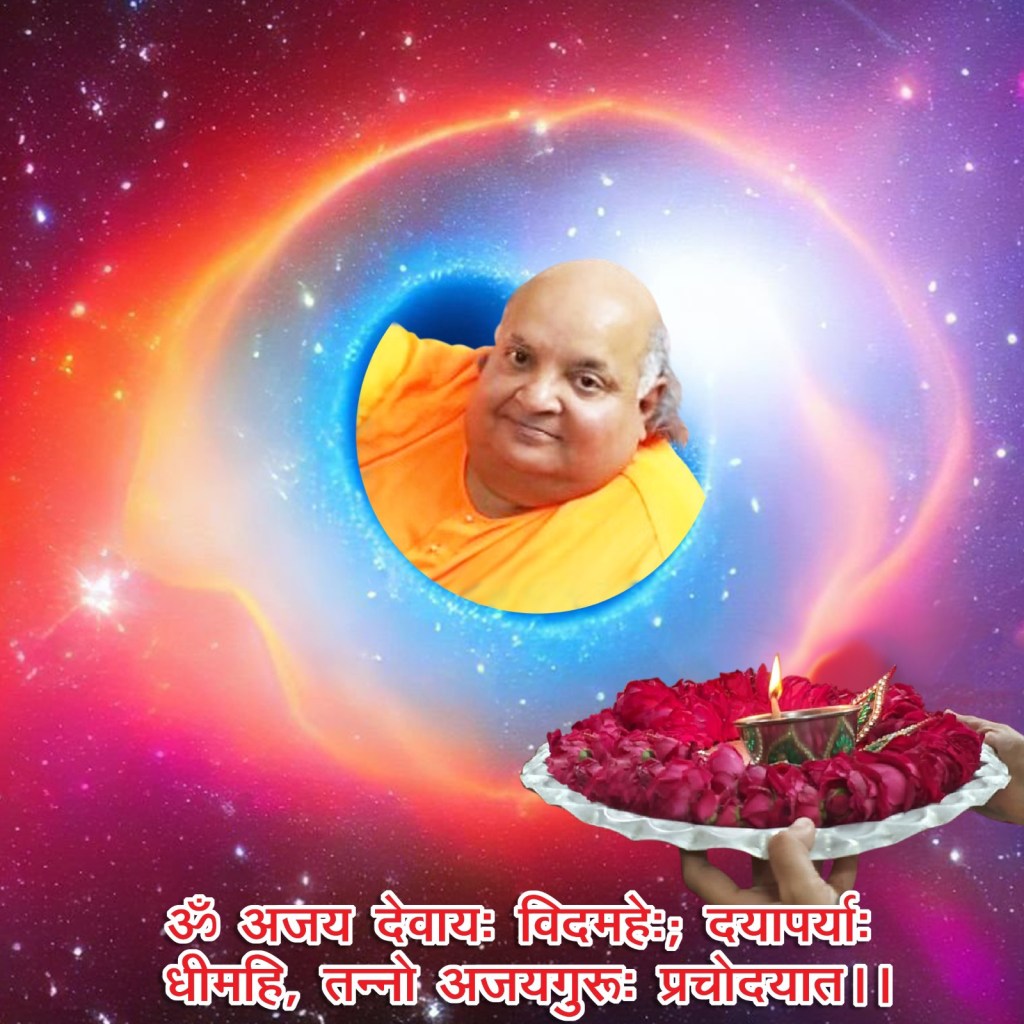
” जीवन सुख – सागर है, दुखों का पहाड़ नहीं …”

Swami ji’s Sandesh …

Swami ji said…

We live in a society which appears to be firmly entrenched in the roots of desires ; thrives on plentiful …’ जहां इच्छाओं का कोई अन्त ही नहीं है…’ and derives false strength from mottos such as – ‘ The more the better’; ‘ Never be satisfied’, ‘ Always ask for more’ and ‘Greed is good’. We celebrate excesses and are embarrassed of moderation and restraint. There is no such thing as ‘enough’, and , anyone who doesn’t want ‘more’ is looked down upon as weak, insignificant and a person not worth reckoning with.

Breathing in an environment that is saturated by
such narratives and ideals – the mind also begins to focus on ‘gains’ and ‘profits’. There is a constant pressure to look for more ; to assess what is lacking and how to acquire it. What one has managed to get in the present moment becomes inconsequential , and , what one doesn’t have – is – what drives our further actions in the materialistic world. Such an approach – unmindful of where it will lead us and what it will turn us into – does eventually lead to material gains … ‘ chahe apna sukh gavan ke.’ Man seeks not just to satisfy his and his family’s immediate hunger, but, also to satisfy their wishes and wants – for far into the future. He seeks not for just his lifetime but for generations after him – irrespective of the consequences that it has on his physical and mental being today. But is this not the mentality of a hoarder? ‘ वो कल के सुख के लिए आज दुःखी रहने को तैय्यार है !’ Can there be any peace in such a constant state of hunger and dissatisfaction?

It is crucial, thus, for us to find a balance. A point at which we can say to ourselves–’This is fine for now. I shall enjoy what I have – now ; and, if the need arises, I shall seek more.’ ‘जो तुम्हारे पास आज है, उस में तो सुखी रहो…ऐसा लगता है कि हम दुःखी होने का कारण ढूँढ ते रहते हैं ‘ – running after material possessions.

How then can we find such a balance? What we need to do is to put on a practical lens in life. We must question ourselves off and on – What is that we seek and why do we seek it ? Why do we need the latest phone? Will it make our life truly better and more comfortable ? Or, have we bought it just to show the world that we are better off than them? Is what we seek something to satisfy our vanity or a requirement? And, yes, sometimes even vanity and appearances are a means to an end in the society around us. Our profession might need us to maintain certain appearances, and , thus satisfying such demands are well justified. But , we must be aware of when we are falling into the rat race and making our lives miserable…’दुखी ‘ in order to present to others that – ‘ हम सुखी है , बहमूल्य, महँगी वस्तुओं के साथ…’ Only we would know about the lengths to which we’ve gone to project this false image of ours to the world.

The spiritual seeker must seek to gain ‘pleasure’ from his current state. He must not just ‘make do’ but ‘make the most’ with what he has. Such an approach towards life gives a sense of fulfilment and gratitude for what one has…’और वह हर क्षण सुख की अनुभूति करता है.’ His happiness and feeling of bliss is not dependent on any recently acquired possessions and for being recognised by others because of them. It also gives one the vision to see what is truly lacking in his life and what he actually needs to secure – with a clear, positive mind – as he knows that what he is embarking upon will be the best for him. In such a state, we do not feel hard- pressed for anything, but , instead are able to act purposefully with a sound aim and a happy mind. The more we honestly seek to answer the question – ‘Is what I have today enough for me?’ – the more will we start seeing how inconsequential materialistic things are in our life. We will begin to achieve more with less, and , our attachment to materialistic and worldly affairs will burn away. The stress of not having this or that ; the fear of being looked down upon and judged with a snigger – all of these will disappear making the mind lighter and the soul happier. The more we learn to enjoy with what we have ‘now’, the more confident and self-assured we will be in ourselves – and the more fruitful and beneficial will be our actions not just to us but for everyone around us.

We must remember – “जब हम, जीवन में जो मिला है , उसका आनन्द लेते हैं और प्रसन्न रहते हैं – उस मे सुख है…और जब हम , जो हमारे पास नही है , उसकी चाहत करते हैं और परेशान रहते हैं…वह दुख है…”

‘सहनशक्ति’

Swami ji said …

For a moment, let us recall the manner in which we react, on seeing a person with an exceptionally strong appearance – who ‘appears’ to be physically fit , exudes power and courage – is in complete command of himself and things around him. Naturally, we are so greatly enamoured by his tough external appearance – that while admiring him – we forget to dwell on an attribute that is most relevant and applicable to his day to day life…’ उस व्यक्ति में ‘शक्ति’ के साथ ‘सहनशक्ति’ भी है या नहीं… शारीर के बल के साथ मनोबल भी है या नहीं !’ Appearances can certainly be deceptive – and we shouldn’t be surprised to find his tough exterior, house within it – a soft, molten, wax – like heart and mind – incapable of bearing , tolerating and accepting the swirling tides of time. Physical strength in all likelihood will weather down with age, but , ‘सहनशक्ति’ – once cemented in us, stays with most of us for ever.

How often have we heard ourselves rant , complain or say angrily – ‘यह मैं सहन नहीं कर सकता !’ Our intolerance level can fluctuate at the silliest of reasons – someone’s arrogant way of speaking with us ; at the thought of someone doing better than us ; it could be due to the heat or excessive cold ; when life shocks us with some heart – breaking news. Why is it that we are unable to take things in our stride ; fail to make an effort to remain unaffected by them and focus on developing mental strength within us ?

The never ending stream of unwanted incidents and happenings in our life can make us feel drained and certain that nothing can ever go right for us. We need to ward off all those weakening thoughts that make us feel – that no one has a life as inconsequential and useless as ours, and, thus , nothing – no amount of effort from our side can ever improve our condition.

But, the truth which we might find difficult to acknowledge, is that, almost all of us have the same misconception. In reality, it is the mind which dictates to us this narrative. It is the mind which puts on its ‘grey ‘ sunglasses to darken our view of life and makes us feel weak and helpless. ‘ उस समय ऐसे लगता है जैसे हम ‘मनोबल और सहनशक्ति’ जैसे शब्दों से परिचित ही नहीं है … हम एकदम हिम्मत हार जाते हैं…’ Life is a constant struggle – sometimes to achieve something in our personal or professional lives; sometimes to improve our health or wealth; sometimes to repair or improve relationships. But, what we need, first, and, foremost to attain any of the above is a lot of mental strength.

It is the mind which detects why something is not right ; why a certain situation is not conducive and what is the reason for us to be miserable about. It is the mind’s perception of the world that is dark and dreary – and not one of the world itself.

So, the question that arises then is – How does one get out of the trap that is laid by the mind ? The answer is quite simple – as is often the case with most battles with the mind. It can be reined in through patience and reflection.We must learn not to ‘react’ but to ‘act’ in the face of any unexpected situation. While a reaction could be emotion fuelled, an ‘action’ will be thoughtful and measured. While one will possibly do nothing to address a situation, the other will make us proceed towards a ‘solution’.

To do this, we must harness tolerance in ourselves. We must learn to accept the ever changing nature of life. We must learn to expect the unexpected and not be surprised by anything. We must tame the ego and submit that the world is not going to change for us; and it is for us to make the most of what we get at any moment or at any time. The more we teach ourselves to be accepting of the world around us, the more we will be at peace.The ups and downs of life will gradually cease to surprise us, and we will gradually build the mental fortitude to adapt to the ever-changing circumstances of life. Meditation makes us immensely strong – mentally and equips us to face challenges with equanimity.

It is only when we have imbibed such an attitude towards life, will we stop ‘suffering’ our lives and start ‘living’ it. We will begin to treat life like a game, created by God – the moves and result of which are already known to Him – and where ‘winning’ is simply doing the best we can at any moment. We will cease to be irritated and irked by anything, but , simply smile at the sudden surprises and shocks that life throws at us.

‘प्रेरणा’

Swami ji said …

An emotion – most negative and overpowering ; extremely torturous and draining – ‘ईर्ष्या’ jealousy’ – has the exceptional ability of switching into ‘active’ mode from ‘dormant’ mode within a fraction of a second – at the most ridiculous of reasons. It could cause us agitation and distress on seeing some one better placed than us ; more affluent than us – who could afford the unaffordable ; more capable and talented than us ; better looking than us. The debate in question could be any – but , it appears , that all we need is a twig of ‘envy’ to latch on to – on knowing that someone is ‘better’ than us – and then leave the rest in the hands of ‘jealousy’ – as it branches out swiftly – in the storm that she brews in us – leaving us raging and seething. ‘How can someone be better than us ?’ – we thunder.

We refuse to listen to the voice of reason – that makes a brave attempt to be heard – amidst the strong gusts of jealousy – when it says – ” जब कभी हम दूसरों की सफलता को स्वीकार नहीं करते, तो वो ‘ईर्ष्या’, ‘जलन’, और ‘नफरत’ बन जाती है… परंतु अगर हम उनकी सफलता को स्वीकार कर लें, तो वही ‘प्रेरणा’ में बदल जाति है!” In which scenario would you like to see yourself ? ‘क्या हमें दूसरों से ईर्ष्या करनी चाहिए या उनसे प्रेरित होना चाहिए ?’

How many of us can honestly admit that , if , we wanted to , we can always learn a lot – the good – at least , from every individual we meet in our lifetime. Each one of us has a story to tell – the story of our life – the incidents of which leave a lasting imprint on us. On hearing stories of success and defeat of others – we, at times, become so greatly envious of their meteoric rise, that we fail to focus on what we should have.The hard work ; the methodical planning ; the systematic implementation of their plans – put in by them to achieve their goal. Rather than being in a permanent state of jealousy which would only hamper any further progress of ours ; it would benefit us greatly if we were motivated and enthused by their determination and commitment to succeed and flourish – and promise ourselves to make an attempt to do something similar.

It takes a big heart to be happy in the success of others and, thus, let us not be small hearted in applauding others for every award and reward that comes their way – owing to their perseverance and tenacity. Jealousy should not make us so miserable and miserly – that we fail to find words of appreciation for the deserving ones – and even if we manage to do so finally, with great difficulty – they seem to get stuck in our throat. This is what jealousy can do to us. ‘ दूसरों से प्रेरित होना… प्रेरणा लेना ‘ – to get motivated by others – in any way, in any field , anywhere – can work wonders for us and we could emerge as completely new individuals – with a new mindset , a better temperament and constructive habits.

If we delve a little deeper into our own psyche, we might discover that strangely, we are not envious of what the other person has achieved. Instead, we are jealous of his ability to put in such monumental effort to achieve success. We find it difficult to believe that someone else can work harder than us. We are unable to digest the fact that another person can make the huge sacrifices that we thought would be impossible. And, instead of admitting this, we find it easier to attribute his success to other factors, like luck, for instance. We are happier finding faults in him, rather than accepting his success, and , learning from their journey.

The love and respect that Bharat, Laxman and Shatrughan bear for their eldest brother, Shri Ram, shines through the epic – ‘Ramayana’. Although they were born to different mothers, never were they jealous of each other, and, instead, so greatly influenced and motivated were they by Shri Ram – ‘ Maryada Purshottam’s’ ideals and principles – that they too much like Him – could do no wrong ; always spoke the truth and obeyed their elders. When Bharat was unable to keep his promise to His father, Raja Dashrath – by failing to convince Shri Ram to return to Ayodhya from His exile in the forest with Him – he then carried Shri Ram’s ‘khadaun’ as a symbol of honouring his promise to his father. Apart from keeping his word to his father , Bharat, refused to sit on the throne of Ayodhya, when Raja Dashrath passed away and placed Shri Ram’s ‘khadaun’ on the throne of Ayodhya instead, as he was sensitive to the fact that the throne rightfully belonged to Shri Ram.” ‘प्रेरणा’ mein bahut shakti hoti hai , jis se insaan kahan se kahan pahunch jaata hai, air uska bhala hota hai…achcha hota hai…”

Swami ji’s Sandesh … "आत्मविश्वास"

Swami ji said…

It is rightly said – ‘Half the battles are won – in the mind…’ And, if we were to deliberate on these words, we wouldn’t fail to agree with their resounding truth – as it would be impossible for us to recount the number of times – that rather than winning – we consecutively lose the mental battle that rages in our mind. An imminent
battle when played
out in the mind – only – makes us feel defeated ; a loser ; the vanquished one – even before we’ve made the feeblest of effort to stand up to the issue and challenge – that awaits a valiant response from us.

But, to be honest are we anywhere close to being courageous, confident and combative to stand firm against the deluge of problems which will undoubtedly attack us in the most unexpected way during our lifetime ? Don’t we buckle under the imaginary onslaught of demoralising and weakening thoughts? Where is that self – confidence … ‘आत्मविश्वास’ – that belief in ourselves – of living up at least to our expectations , if , not to that of others ?

In real life – we will be defeated or drubbed, many a times, be it on the sports field or the professional field of our choice. We win some rounds and we lose some. That is the way life goes. But, the context of defeat needs to be understood – ‘मैदान में एक हारा हुआ इंसान फिर से जीत सकता है … लेकीन मन से हारा हुआ इंसान कभी जीत नहीं सकता ‘…It is a curse that one has to live with – as nothing can be worse than lack of self confidence as – ‘ हमारा आत्मविश्वास ही हमारी सर्वश्रेष्ठ पूँजी है…’ We are nothing without it. Low self esteem tends to make us feel insecure , incapable of enduring the struggles of life – as we start believing that we are not equipped and competent enough to cross the twists and turns of every day life. Over confidence can, at times, be the end of a person – but to make new beginnings, breakthroughs and burrows – the only key that can unlock the above – is self – confidence. Rather than getting into a shell – we should welcome the ‘challenges’ that come our way – as they alone can bring about unprecedented ‘changes’ in us – when we grow aware of the need of mustering up confidence from within ourselves – and are pleasantly surprised to see ourselves rise stronger than expected.

We must strive to possess the mental strength that was displayed by Lord Ram at many stages of His life. Although born a prince , He dutifully obeyed the Queen Mother – Kaikeyi’s instruction, to live in exile in the forest for fourteen long years, without asking any questions or putting up any resistance. Armed with self – confidence, not only did He complete His period of exile , but also, vanquished Ravan, the demon king – with a small ‘वानर सेना’. The misconception under which most of us live that only – power, position and golden robes – can instill self – confidence in us needs to be corrected at the earliest. Possessing only an impressive physical appearance – devoid of self – confidence doesn’t help in the long run. It is better to be simple and plain – and , yet , be sure , certain and self – confident.

‘सत्य’ का महत्व

Swami ji said …

“ Truth will set you free…” “Honesty is the best policy…” All of us have heard these sayings ever since our childhood. Our school textbooks are filled with stories teaching us about choosing the path of honesty as it will always serve us well. We are told that God is observing us and that we must not lie. To be dishonest is equated to being ‘evil’. We are told that under no circumstances are we to ever lie or cheat others , for , there will be ‘hell’ to pay later.

Yet, when we observe people around us – family, friends, society at large – what comes out vividly is that none of these teachings are being truly practised in letter or spirit. At least not by the majority of the masses. We see untruth and hypocrisy being practised all around. In fact, lies and untruths are many times used to earn a living. Even the law of the land is manipulated and twisted to let the ‘guilty’ escape with their ‘lies’. We might be working for a company that could be deceitful to its customers; or , even to its own employees. We might notice our superiors or subordinates double dealing and cheating. We might see family members engaging in ignoble behaviour at work. We too might be coerced to lie – to save a loved one ; to protect our livelihood, or , to avoid an unpleasant situation. In such a case, what is the meaning of ‘satya’ in our lives and how do we go about incorporating it in our lives ?

For a start, it is important to acknowledge that the world we live in – unlike the world in our books – is infinitely more complex. We live within the boundaries of society – समाज – and we have to adjust accordingly for our own survival and well being. But , that being said , we must fight the urge of giving into the thought – that since everyone lies – why can’t I ? And, while we might see people blatantly profiteering from dishonesty, we must resist the temptation to indulge in such behaviour ourselves. At such times, it will seem that being truthful is ‘hurting’ us in a material sense, but , we must realise that any such materialistic sacrifice that we make , to stay on the path of honesty , will only benefit us spiritually.

We see groups of people around us today referring to each other as ‘friends’, but , many a times, they could be bickering and gossiping – behind each other’s backs. Social media is used to show the world our ‘good side’ and our ‘great lives’. These so called friends only compare each other’s lives and possessions. Is there any ‘reliability’ and ‘truth’ in such relationships ? Can there be any trust and comfort between such people? It is only when people are honest – when they are willing to speak their actual minds and open their hearts, show their vulnerability, can they invite empathy and understanding ; markings of true friendship, into their lives.

Many times, it is difficult to keep one’s word. We see people giving false excuses.This is often because it is inconvenient for them to stay true to their word and maybe they do not want to go through the struggle of doing so. It is easier for them to break their promise and deceive others. But, it is precisely this effort and struggle to honour our commitments, act in alignment with our values, and remain true to ourselves, that cultivates steadfastness in us.This integrity that we develop becomes the compass that navigates our choices, leading us to a state of fulfilment and an assured confidence in ourselves while speaking the truth.

There is a general perception and fear that the path of honesty is difficult and demands great sacrifice. But, in reality, it is one that unmasks all the illusions and facades – that life surrounds us with. Honesty is not just about speaking the truth , but , is also about having truthful internal conversations – accepting our faults and limitations and looking into the deep recesses of our mind. Yes, seeing our drawbacks hurts ; accepting our failures also hurts ; but, just like the body’s muscles must first be broken to grow stronger and bigger again, the breaking of our – भ्रम – of what we are in reality – gives us an opportunity to make our character stronger and better.

We must remember that a truly honest person becomes highly self-aware, and, develops the self-mastery needed to progress in life on the simple and noble path of ‘satya’. The spiritual seeker must embrace honesty, at all times, as it is only continuous and determined attempts to stay honest ; to speak the truth – that will reveal to him the true nature of this world. He will develop clarity, and strive to be honest ; gradually peel away all the layers of ignorance to discover his true original self – unspoilt by untruth and dishonesty – the way God had meant him to be. Honesty is the one virtue that can grant us liberation from this world. ‘ सत्य के पथ पर सदैव चलने से ही हम सम्पूर्ण सत्य को प्राप्त कर सकते हैं … ‘