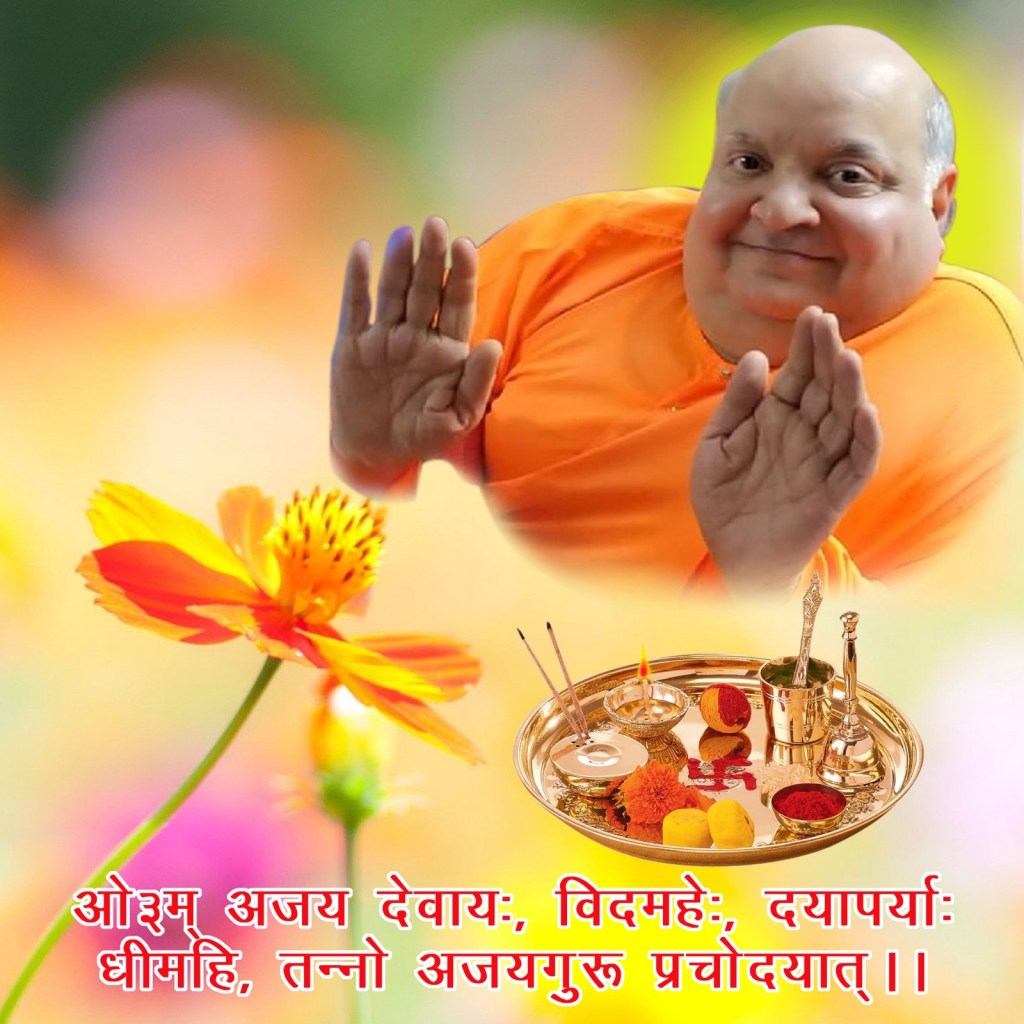
Swami ji ‘s Sandesh… ” ईश्वर में अटूट आस्था रखो… वह ही हमारे असली आश्रय हैँ…”

Swami ji said…

Man lives his life completely immersed in it. On perceiving that everything is going well with him and his loved ones, he begins to think of himself as a master strategist – ‘the’ one who had called all the right shots and had taken all the right calls at the right time. He attributes his success solely to himself, his brilliance and greatness. He tells himself proudly that he is a winner in the game of life and will always remain so. All the people around him too heap praise on him and shower him with admiration. Don’t most of us feel these emotions course through our being too when we succeed ? Don’t we feel proud of ‘ourselves’? In fact, so busy are we in
self-admiration , that we completely forget – or are perhaps too egoistic and proud to admit – that whatever we are today – was not just due to the result of our actions, but also, because of every little circumstance that was created by an ‘invisible hand’ – that is always guiding us, nudging us in the right direction – to the point – where success is literally carried by Him – to us ; for us. But, we are somehow hesitant in acknowledging His role ; the constant support that He not only provides but carries for us.

If we laud and cheer for only ‘ourselves’ in the good times, we are bound to feel ‘alone’ and ‘isolated’ in the ‘bad’ times too. A mind that cannot acknowledge the blessings of God in victory, will be unable to seek His solace in defeat. Even an atheist will find it hard to believe that ‘chance’ or ‘luck’ can only be bad and not good. If we attribute our failures to ‘bad luck’, then, surely our victories are a result of some ‘good luck’ too.

It is not failure alone that hurts or pains us. It is the feeling of loneliness, the pangs of despair and uncertainty that one experiences – while frantically looking for some support and direction – from those who matter to him. It is that sense of being isolated that make the mind and heart suffer. If only we had humbly given God His due earlier, when basking in glory, He too would have been able to give us His light in times of darkness and obscurity.

Then , there are those among us who proudly make ‘back up’ plans. They bank their confidence and expectation on their loved ones, family, accumulated wealth – convinced that the great support system that they have to back them will get them through the toughest of times. All these reassuring factors make them feel that all of these are their very reliable , dependable support system…’ हमें इन्ही चीजें का सहारा चाहिए होता है – क्यूंकि हमें लगता है कि यह सारी चीजें ही हमारा असली सहारा है और इनके सहारे से ही हमारा जीवन बहुत अच्छी तरह से निकल जाएगा…’
It is nearly bizarre that we have such great confidence in ‘maya’ but not in the One who has created it. And, while we certainly need food, clothing and shelter to sustain and shelter ourselves, to live a life with dignity – these still cannot nourish and strengthen the mind and soul – spiritually. It takes only a few misspoken words for relationships to turn sour and only a few mindless actions to lose our wealth. How can one be sure of strong support from that which is so fragile and fickle ?

The spiritual seeker must practice gratitude to God ; gratitude for even the smallest of joys and kindness that comes his way. It is this practice that gives one the vision to see God’s hand in our daily lives. The more we see this, the more we will surrender to His will. Life becomes a playground of sorts for us. We become curious, rather than fearful when the unexpected befalls us. Our belief in the fact that as long as we do right – God will do us no wrong begins to strengthen further – and we simply take the next best step to see what He has to unravel to us. In such a state we do not experience the ‘highs’ and ‘lows’ of life, but , rather begin to take joy in our actions. We then begin to devote our work, our dreams, our aspirations, our struggles – everything to God. Success for us becomes not the results of our actions purely, but, also how successful He wants us to at that particular point in life. When we face failure too – and although it hurts us a lot then – we realise later that it was because He had willed it that way – and while extending His support to us, He , guides us to what is destined for us.

” सोच विचार कर के ही शब्दों का प्रयोग करो…”

Swami ji said… When we look at or think about others, we are not really surprised at seeing,or, realising that each one of us is an intriguing, fascinating combination of different emotions. Emotions – typical and distinctive to each one of us – that run strong in us – make us interact and deal with people – the way we are made, emotionally. Our behaviour , attitude, beliefs – clearly reflect our emotional characteristics – and that is what makes others – either walk towards us or turn away from us. There are some of us who are so emotional , so direct , forthright and straightforward that we are what we are – inside out – and speak out our mind , aloud – without thinking of the consequences that our clear , honest and direct words could have on others. Then there are a few among us who get so carried away by their emotions of happiness, anger or grief – that they make the mistake of – “आनंद में वचन दे देते हैं, क्रोध में उत्तर दे देते हैं और दुःख में निर्णय ले लेते हैं …” We must remember that the weight of words is measured in gold, and, thus words that are said by us in any situation – do not become meaningless or worthless – but, rather, heal than hurt ; mend than destroy ; convey love than hate. With a little bit of self – control and restraint we can master the skill of using the right words at the right time – thus hurting no one around us. Words once said can never be retrieved or taken back. Utmost caution needs to be exercised with words while we speak – with all those – with whom we have some
relationship or another. Words – incorrect , inappropriate and wrong – said at the spur of the moment – can hurt a person so deep – that regret or repenting over them later – proves to be useless. Misunderstandings that can never be resolved, end up lasting for a lifetime, and, all the goodwill and affection that one had borne for the other is washed away – that very instant and becomes a thing of the past. The power of words – the effect that they have on others – somehow has always been taken lightly by us. In all likelihood , we fail to see the value of commitment in the words that are said by us while making a promise to someone. A spiritual seeker should understand the sacred nature of the words when he says – ‘Gurudev, yes , I will ! ‘ and promises to obey a certain instruction – ‘aadesh’ that his ‘guru’ issues to him for his personal spiritual growth and improvement. How unfortunate would it be , if , we were to make a promise in our ‘guru’s presence – just to please Him and then completely forget to abide by it and make it an integral part of our life on a daily basis from then onwards.Why make a commitment that we are unable to keep ? If we were to reflect, in isolation, on our verbal reaction to others, when we are angry and enraged , and , although we might not admit it – we would actually hang our heads in shame. The contempt and impoliteness in our rude words to, maybe, even an unsuspecting person who might have bumped into us accidentally – could make us feel terrible later ; but then what is the point of being apologetic , unless and until, we promise to transform ourselves into better individuals. Many a times, when we see grief – stricken people around us faced with an unexpected tragedy, we are so greatly affected and overwhelmed by their sorrow – that we decide to stand by them as a pillar of support, and, be with them through thick and thin forever – but then what happens to that hasty, emotional decision of ours shortly – ” कुछ ही समय में हम सोचते हैं कि अपने ऊपर हम ने ये क्या जिम्मेदारी ले ली और अपने निर्णय पर पछताते हैं…” This is how fickle we can be – even to the words that were said by us – to ourselves. Let us remember to be careful and mindful of the words that are used by us while speaking and communicating with others.Hurtful words that had been said a long time back by someone to us are, strangely, never forgotten by us.Relationships that had been built over years are destroyed forever, within seconds, when we use words that cut and wound so deep – that those relationships can never be healed or repaired in future. Why should we ever do that ?

“सुकून”

Swami ji said… We are all aware of what a tornado is. A swirling mass of air that lifts and carries away everything that comes in its path to great heights before they come crashing down to the earth again. Now, imagine being stuck in one such tornado, being mercilessly swept up and thrown in the air like a doll, while we flail our arms desperately in the hope of holding on to something – to stop us from being carried away. The fear, the helplessness, the despair in such moments cannot possibly be imagined and explained, unless one experiences it himself. Yet, a little bit of introspection, will reveal that this is exactly what man’s state of mind is nowadays.
सुकून’ – ‘Kya yeh aaj ek aisa ehsaas hogaya hai , jiss ke anubhav se hum koson dur hote jaa rahe hain !’ If, yes – if the distance between us – our body, heart , mind, soul – and this soothing , calming , relaxing emotion has grown or is growing in leaps and bounds then – who could we blame – but ourselves – for alienating ‘it’ from ‘us’ or to be honest – ‘us’ from ‘it’. Where have those days of peace and quiet; genuine joy and contentment gone? Why have the happy, smiling faces that surfaced around us in a large number, in the days gone by – been replaced by sullen, stressed out, frowning faces? What has brought about these changes in us? The answer lies, of course, in man’s constant need for ‘more’. It appears that we have knowingly taken an oath that – ” रोज़मर्रा की जिंदगी में हम सुकून से अवगत ही नहीं हो सकते; सुकून का एक दिन भी नहीं बीता सकते है…” maybe, because we know that our choices; our priorities; our adopted lifestyle; the overzealous streak of competition that we have in us – does not let us be at peace, be it day or night. At night, with conflict raging in our mind, we toss and turn, desperate to sleep as it evades us. Our physical body, for all practical purposes, could be in a state of limbo – but the mind is overactive – analysing, dissecting the ways and means of procuring and acquiring – more and more – agitated as to why is it unable to surpass the glory achieved by others. The word ‘enough’ seems to be a word suitable for yesteryears. Sadly, today, most of us are unable to relate with the crisp sound of ‘enough’ – even if we were told about the peace and contentment that could be experienced by us on realising – that what we have acquired so far – is more than enough for us. We must question ourselves – ‘क्या हमने अपना सुकून अपनी इच्छाओं को बेच दिया है?’ Has this transaction been worth it? Is not the price at which we brokered this deal costing us and our state of mind dearly ? We truly must give this serious thought and reflection.
In life, God will always guide us. He will tell us, in His own ways, what we must truly strive for. What we don’t need as per Him, He will not allow us to have; but , what He believes is suitable for us ; required and deserved by us – that He will ensure we get unfailingly. When ‘need’ motivates us, we must work hard to achieve our goal. But when ‘greed’ motivates us – we must check ourselves and ask ourselves – ‘what’ we are doing and ‘why’. There is a difference between a businessman who wants to ‘excel’ at his business and one who simply wants to make ‘more money’ from his business. We should judge neither, but , it is important to realise as to what it is that ‘motivates’ their actions. In fact, from the outside , both might appear to be doing the same thing. But, while one acts on the ‘need’ to fulfil his potential; the other ‘wants’ to only ‘fill his pockets’. While the former is fulfilling his role as a ‘karm yogi’, the other comes across as a greedy ‘bhogi’. One will sleep peacefully at night – filled with hope to work harder the next day ; while the other will stay awake – feeling dissatisfied that he was unable to fill his coffers enough – to show to the world. Thus, we must strive to erase ‘greed’ from our heart and mind. We must ceaselessly look for ‘balance’ in our lives. We must try to find constantly that which is enough to sustain us and our loved ones. Such a way of life will make us aware of our ‘needs’ and strip away illusions and fears of not having enough. It is only then that we will be able to truly enjoy life and its gifts to us – with a mind at peace and a heart that is content. It is only then that we will start being grateful for what we have and with all what we get in life.

” ‘सच्चे संत’ अपने भक्तों का साथ कभी नहीं छोड़ते हैं …”

Swami ji said…

Celestial bodies like the Sun and the Moon have been worshipped and looked upon with great reverence by man since ages. The moon – a celestial body most beautiful and fascinating – is a vision – spectacular and enthralling to behold – on ‘ पूर्णिमा’ in particular – as it reveals its breathtakingly divine beauty – in its complete glory to us. Colors as varied as molten orange to an iridescent silver blue emanate from it, eradicating the darkness of the night with its soft , luminous light ; much akin to the gentle manner in which a ‘सद्गुरु’ removes the layers of ignorance, darkness and impurities – that have settled on the ‘soul’ of his ‘भक्त’ over his previous lifetimes – thereby preventing the ‘soul’ from understanding its primary goal – which is to seek liberation from the cycle of birth and death – by cleansing itself , by purifying itself – ‘अच्छे ‘कर्म कर के, सत्य के नेक मार्ग पर चलने से…’

Devotees celebrate ‘गुरु – पूर्णिमा’ with great veneration and devotion for their ‘gurus’ – while ‘they’ are with them in their physical form and even after they have taken ‘महा – समाधि’. The Sun , moon and the stars are visible to the naked eye during that particular of the time of the day or night that is allotted to each one of them by the Creator ; and even when they are not seen by us – depending on whether it is night or day , they are very much present in space and time. In a similar way – ‘सच्चे संत’ and ‘सद्गुरु – whether they are physically present with their devotees or have discarded their physical robe and merged with divinity ; they constantly take care of their devotees ; look out for the adverse situations that could be awaiting them and provide them with the mind , heart and strength to endure them ; assess what would be best for them and provide them with ‘that’ – whether it is appreciated by the devotees or not – as He alone knows what would be best for them in the long run.

A ‘sadguru’s’ love for his devotees is eternal, everlasting – not affected by the waxing or waning of the moon – and burns bright like a lit up wick of a candle – for the welfare and well being of his devotees, filled with love , concern and compassion for them. The full moon is sixteen times more powerful on ‘पूर्णिमा as compared to other days – and so is the spiritual power of ‘sadgurus’ – ten days prior to the auspicious day of ‘guru – purnima’ – the divine energy and strength of which cannot be withstood by normal beings like us. But the love that He bears for His devotees – ‘ उस में चाँद की किरणों की शीतलता, करुणा और दिव्यता होती है और वह यही चाहते हैं कि उनके साधकों में भी ऐसा गुण उत्पन्न हो…’ Much like the manner in which the full moon’s radiant light tries to reach out to the darkest corners of the earth’s surface and embrace them – as though reassuring them that there is light in darkness – a ‘sadguru’ too accepts His devotees the way they are ; even if they have hit rock bottom and there is simply no hope for them. ‘He’ takes upon Himself the responsibility of providing them with that beam of moonlight – in the form of hope and surety that their days of darkness will end one fine day – and many a times with a ‘guru’s’ divine grace – everything works out well for them in the end.

When we look at a bright full moon – a spontaneous smile comes to our lips – as its delicate, heartwarming beauty tugs at our heart – forming an immediate spiritual connection between us.
Similar is the case when we look at the blissfully divine face of our ‘sadguru’ – a face that radiates positivity ; instils faith and belief in us that a day will dawn when we will be able to get rid of – rise above all the negativity that creeps in within us – and we too will shine bright and strong – both physically and emotionally – with the ‘ज्ञान’ that is imparted to us by our ‘सद्गुरु’ – growing multifold while absorbing His pearls of wisdom ; basking in His unconditional , divine love for us – be it ‘अमावस्या or ‘पूर्णिमा’ – क्योंकि वह हमारा साथ कभी नहीं छोड़ते हैं, चाहे दुख हो या सुख, सदैव हमारे साथ रहते हैं और आगे बढ़ने का रास्ता दिखाते
हैं…”

” रिश्तों को निभाने में झुकना पड़ता है …“

Swami ji said…

” रिश्तों के बंधन में हम तभी से बंध जाते हैं, जब हम अपनी माँ के गर्भ में होते हैं ” – and all the family members to whom we will be related after our birth ; not only, do they await our birth eagerly, but also, start discussing animatedly about the best characteristics that we could take from our parents, and, the kind of person we would grow into – with time. Would we be stubborn or docile? Arrogant or humble? Selfish or selfless ?Truthful or deceitful? Because more often than not – we tend to retain the same very traits, throughout our life, that we had during our childhood – and the ‘typical’ kind of individual that we are – with our positives and negatives – is what lays the foundation of relationships that we form and develop with our family and friends – as we evolve.

” रिश्तों को बारकरार रखने में… .” to understand how relationships are maintained, we need to take a leaf from the ‘stem’ of a tree – the flexibility of which helps the tree to stand rooted to the ground even while it bears the onslaught of a havoc wreaking storm. In a similar manner, if, we were to adopt some flexibility in our behaviour, instead of being stubborn and rude – we would unfailingly succeed in winning the hearts of people around us – all those who matter the most to us; love us; care for us. At times, we fear being soft, yielding, and adjustable all the time – as we feel that others could then categorize us as being spineless and weak. And, while we should be strong and undeterred in matters of honesty and principles, we must realise that it is always good to give others space to be themselves, and, be accepting of their nature. It is only when we show a non – judgemental acceptance of others, that we too can be accepted by them.The lesser we ‘preach’ to others; the more likely they will listen to us when it matters. The more we let others in on our conversations ; the more we let them express themselves ; the more will we understand each other.

The basis of any relationship is love and respect. And where there is jealousy and hate; suspicion and fear, there can be no love and respect – there can be no comfort and calm. As children, it is based on these feelings of trust, and affection that we make friends – some of whom stay in touch and remain close – long into our adult lives. They are neither our relatives nor are they bound to us by blood, but, despite that – they remain integral in our lives. This is because the relationship we have with them carries a childlike innocence – untouched by pride, jealousy or competition and also because we accept them as they are – without judging them.

Thus, it becomes important to put in these same characteristics into our relationships with our relatives. We must strive to be dependable and trustworthy – and for this we must give up any sense of superiority or a ‘mindset’ that restricts us from being so. We must stop all comparison and cease keeping count of ‘what we did for them’ and ‘what they did for us’. All gestures must be seen for exactly what they are – gestures – and not measured in materialistic terms. It is only then we will be able to experience genuine love, understanding, compassion and respect for them. Misunderstandings , if any , should be resolved at the earliest between parents and children; between siblings and between spouses at the earliest. Sincere attempts should be made to diffuse problems that will undoubtedly arise in a joint family in particular. Disharmony and discord has been of no good to anyone – so why let it live in your family ?

In the times that we live today – where many filial relationships are as fragile as crystal and breaking meaninglessly – we would not have been either surprised or shocked to hear that Lord Ram had found Queen Kaikeyi’s wish for Him to banished into the forest for fourteen long years to be unfair, unjust and had refused to fulfil it. Had He ignored her wishes; we would have found His reaction to be perfectly normal in the world that we live today. But, in comparison, those times were vastly different, when relationships mattered the most – and Lord Ram even in such demanding circumstances, did not let His relationship with Queen Kaikeyi deteriorate. Why did He do so? Could it be that this was God’s way of teaching us that the relationships we are born into must be upheld and maintained even at the cost of great personal sacrifice ? Is it God’s way of saying we must strive to keep these relationships alive to the best of our ability? How about our relationship with God ? Don’t we sometimes disconnect with Him, in anger , when things are not going our way, and , sometimes completely forget Him when they are ? Perhaps we need to display some humility here too. If our relationship with Him is only transactional, then the ups and downs, the numerous vagaries of life will strain this divine relationship too. We must tame our ego and accept that only He knows what is best for us. Like a friend, we must trust Him completely. Would not a friend feel bad if we refused to share our troubles with him? And would it also not sting him if we didn’t share our happiness and joys with him? Why then should our relationship with God be any different ?