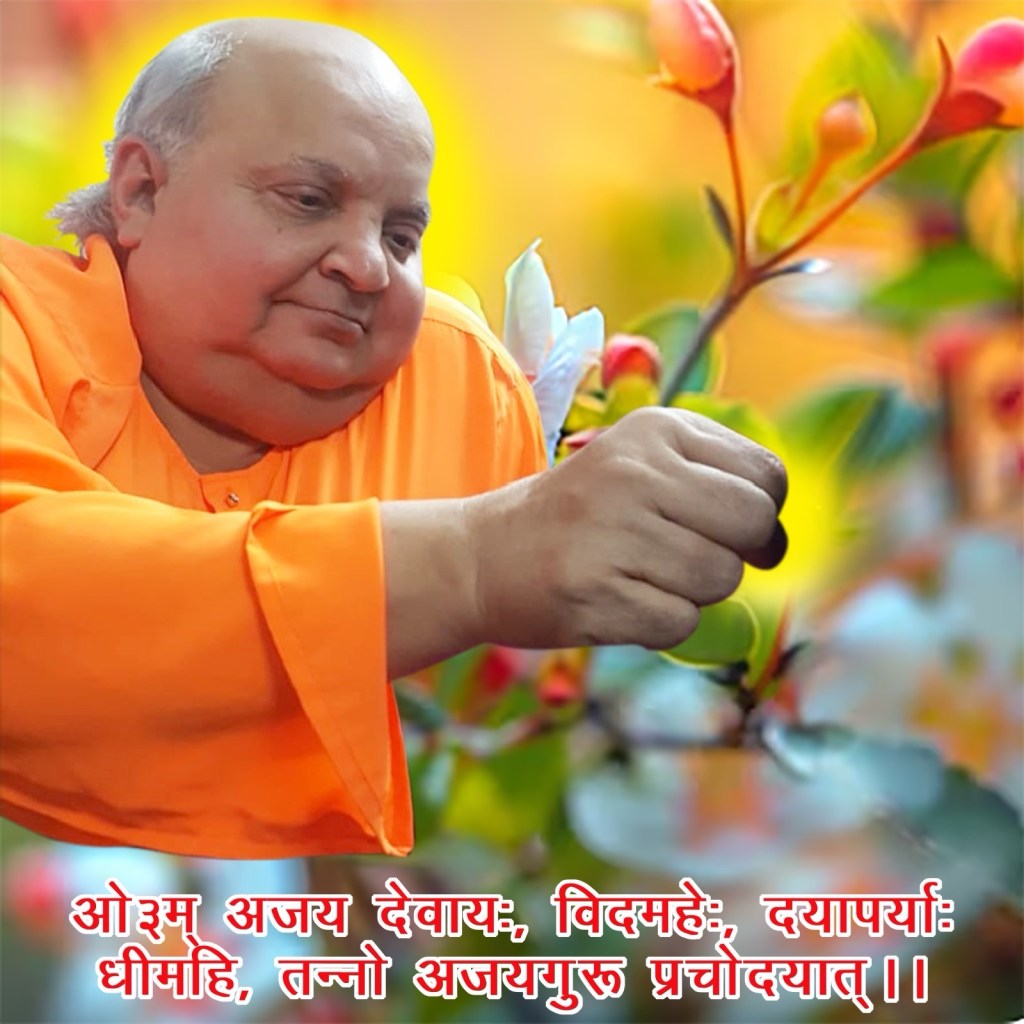
Swami ji said…
“बहुत टेंशन चल रही है आजकल…” “Life is so stressful…”
“तनाव के कारण मुझे नींद नहीं आ रही है…” These are emotional expressions heard very often by us today. They convey the frightening degree of emotional distress, strain and pressure which seems to be overwhelming many, many people — eventually leading to poor health, medical complications and, at times, even a complete nervous breakdown.
But instead of merely repeating these melancholic words, do we ever stop and try to understand the reasons that we allow such havoc to be created in our minds, in such an uncontrolled manner, causing anxiety, restlessness and mental disarray within us?
Is this not, perhaps, one of the worst punishments that we can inflict upon ourselves? How do we manage to get ourselves entangled in a cobweb of our own making? The answer, perhaps, is known only to us…“हमने क्या अपने आप से, दूसरों से और ज़िंदगी से कुछ ज़्यादा ही अपेक्षाएँ और उम्मीदें लगा रखी हैं— जो सच्चाई से कोसों दूर हैं? क्या हम किसी भ्रम में जी रहे हैं?”
Is it possible that the gap which exists between our ‘expectations’ from life — from ourselves and from other people — and the ‘reality’ of our lives, and the manner in which we live out our lives, could be one of the major causes of the apprehension and uneasiness that creates stress within us?
Do we ‘expect’ too much from life, while remaining unwilling to ‘accept’ the everyday occurrences of life when they turn out to be a far cry from the reality that we had imagined?
And what is it about man’s obsession with not letting go of his past? Why does he insist upon carrying its heavy burden along with him— loading an already burdened heart and mind with the additional ‘fear’ of the ‘unknown’? That unknown future which, by God’s will, he may perhaps never even have to face.
Won’t man’s negative habit of constantly anticipating the worst that could happen in his life gradually fill him with sadness and despair— nullifying even the humble attempts made by happiness to enter his doorway?
Happiness may knock gently, again and again— but a mind occupied with sad memories of yesterday and fears of tomorrow may fail to hear it. Thus, sad he remains— increasing his own uneasiness, anxiety and stress.
Mistakes are made by nearly all of us— major or minor. In fact, some people have benefited greatly by learning from the mistakes made by them, which later proved to be life-changing.
Of course, one is filled with regret for having erred, for having made a mistake. But merely regretting it forever, and not moving ahead, will neither serve any purpose nor do us any good, except keep us living in tension. A mistake should teach us — not become a burden that we carry for the rest of our lives.
Just like a bird that leaves behind all its fears, sadness and regrets and takes a new flight, we too must shed the baggage of the negative traits that reside within us and begin anew with a positive thought process. There comes a time when one must say to oneself:
“जो हो गया, उससे सीखो— लेकिन उसे लेकर जीते मत रहो…”
The spiritual seeker must realise that the mistakes of yesterday are lessons that we are meant to remember today. They are meant to give us the wisdom to act correctly in the present. And when it comes to the uncertainty of tomorrow, one must learn to let ‘tomorrow take care of itself’.
The spiritual path is no less daunting than everyday life. One will fail repeatedly. One is bound to err. But that is not an aberration from the spiritual path; in many ways, it is the path itself. God will not be realised in one day— or perhaps even in ten thousand days.
One’s spiritual practices today might seem perfect. One might experience great changes and feel that one has made tremendous spiritual progress. Yet tomorrow may reveal how far one still has to go. And the day after may expose flaws within us that we never even knew existed.
This may happen numerous times. Again and again, the spiritual path may appear challenging. Repeated failures may create within us the stress that arises from feeling ‘unworthy’. But even at such times, one must remember- ‘One can only do one’s best’. Perhaps that in itself is among the highest forms of ‘karma’ available to us — to act sincerely, to correct ourselves when we fail, to continue making the effort, and then to surrender the judgement of our efforts to God.
Let God, and God alone, decide the ‘worth’ of our actions and our efforts.
Our duty is to act with sincerity. The result, the judgement and the final measure of that effort belong to Him.
Perhaps a great deal of our stress does not arise merely from what happens to us. It arises from our insistence that what happens to us, with us, around us – ‘should have happened differently’ — from our inability to let go of what has already happened, and from our fear of what may never happen at all.
This dilemma — this incessant and self-defeating thought process — can perhaps be overcome only by practising the acceptance of life as it really is. One must stop fantasising about what a ‘perfect world’ should be, and, instead, become curious and enthusiastic about seeing how life actually unfolds before one’s eyes.
Yes, this may sound odd. But if we learn to embrace the uncertainty of life, and, even begin to appreciate the manner in which life so often defies the expectations of our own mind, we may find ourselves far better equipped – to handle whatever comes before us.
We may then find that we spend far less time cursing our luck and instead spend far more time focusing on the task at hand. We may also spare ourselves much of the emotional upheaval that so often arises when we feel caught unawares by life. Take joy in life as it is. Marvel at how suddenly it can change. Learn from its impermanence that detachment is one of the keys to protecting oneself from grief.
Remember that nothing lasts. Death is a certainty — not only for man, but, eventually for everything that he considers his own: his possessions, his name, his fame and his relationships. Everything, in time, comes to an end. And thus, there is perhaps nothing that we can gain or lose in this life that is truly more valuable than our ‘soul’.
Life is a ‘गुरु’ in itself. It is constantly showing us what we need to focus upon and what path we must take. If we observe it carefully — with a pure heart and a clear mind — we may begin to realise that life is not a struggle meant to break our spirit, but, a journey meant to uplift our ‘soul’.

