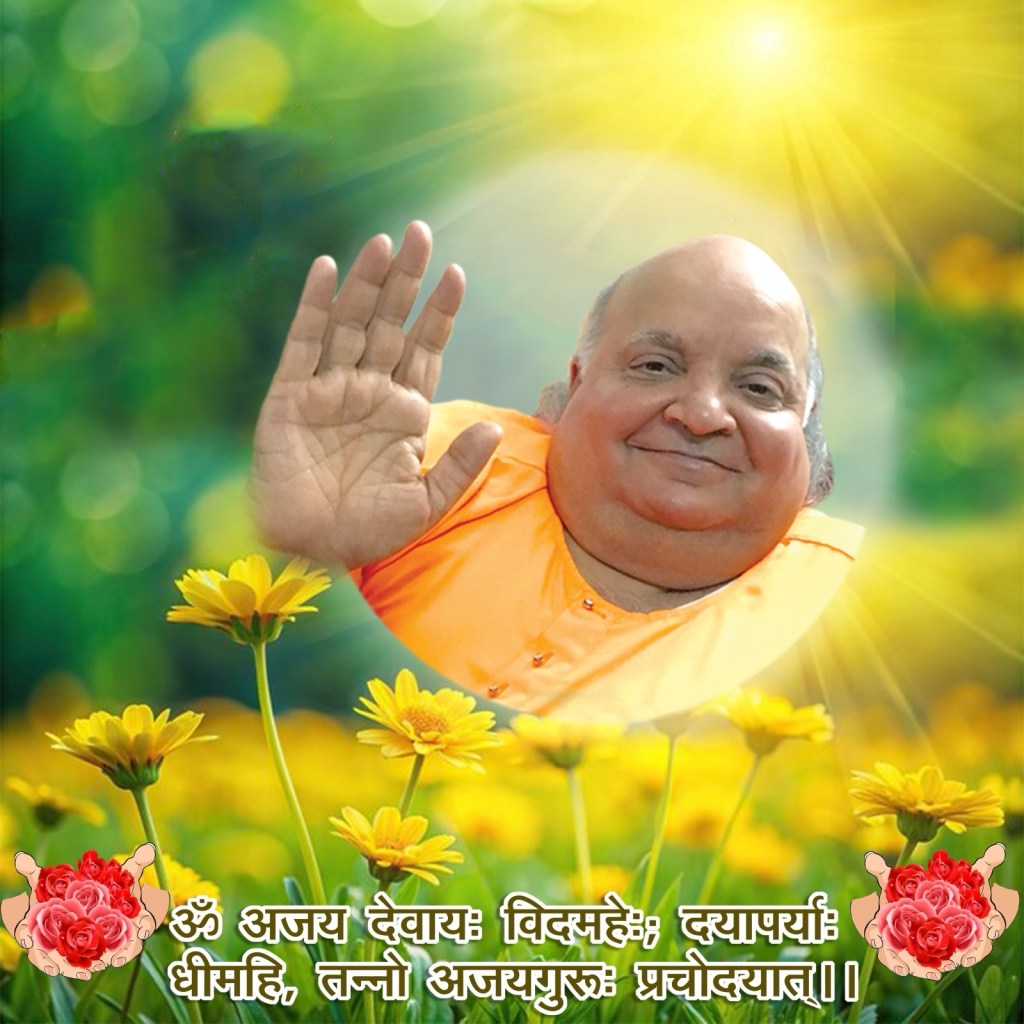
Swami ji’s Sandesh… ” ‘खुश’ रहने के लिए बाहरी चीज़ों का सहारा मत लो…”

Swami ji said…

Do we ever consider and reflect on the kind of surroundings ; or at what time of the day ; or in the presence of which people – is it – that we have mostly found ourselves to be happiest or most joyful ? The chances, most probably, are – that there is no such common thread to be found. There is no particular place ; no particular time of the day ; or season ; no particular person’s presence ; no physical conditions which could have guaranteed a permanent and long lasting positive effect – on our mood ; our state of mind. We can be happy in the sweltering heat of the sun, and, be sad in the cool environs of our home. We can be exuberant in solitude, and , be depressed in the presence of even our loved ones. Even the opposite of these hold true.

Yet, inexplicably, we , still live life with this almost singular approach – to obtain that – which we think will make us happy. “If I could go on a holiday there, I will then be happy !” “If I could buy a house there, I will be happy then !” “If I could buy this watch, this car, then , I will be happy !” “If only he or she would listen to me, I would then be happy”. There are always these numerous terms and conditions – which we set for ourselves needlessly – the ownership of which once accessed – we make our ourselves believe – alone will guarantee our happiness. And, more often than not, we spend a lot of time and energy focussing on making these things happen, and, do not even allow ourselves to be happy otherwise.

But, that is not how God made us ; that is not meant to be our sole purpose. Man’s sense of hunger was meant only to indicate a sign – that he was hungry – to eat food, ; and his thirst was an indicator – that he had to drink water. With a full stomach and quenched thirst, he , was meant to be content physically, and, could then address his mind. But, now, man, hungers for things like status, wealth and power – mistaking them as his needs. Without these, there is no relief in his mind ; and , even with these – there is none. Such struggles and labour – are eventually, going to be futile , if , we are looking for ‘pure’ contentment and ‘genuine’ happiness. For , there will be no ‘true’ happiness found at the end of such journeys.

Yes, we , need physical comforts. We need homes, jobs, decent living conditions etc. We all have to strive to obtain these. But , that does not mean that everlasting happiness is dictated by them ; can be obtained by them. Does not happiness arise from the heart? And , if , we were to be realistic , we would understand that it is actually the smallest of things that make the heart happy ; and this is what we mostly miss out on.

Can we not enjoy a cup of tea in the morning – without stressing about the tasks of the day ahead ?Can we not have a light hearted laugh with the shopkeeper we buy our groceries from, or, with our colleague at work? Or , bring a smile to our children’s faces with a funny joke?Can we not be grateful to God when we are able to eat a nice hot meal at home? Can we not take out just a few minutes in a day to help someone out with a task?

Does not such a life already seem to be filled with happiness ? Would leading such a life not guarantee that one has a day – with the occasional spark of joy? With such an attitude – the problems, trials and tribulations of life will be met with a smile. All endeavours will be made – not with the tension and pressure of having to succeed, but , with confidence and a smile on one’s face.

The spiritual seeker must learn to untangle the threads of the sensory world, societal expectations – from those of the spiritual world. He must learn the simple truth that – he ‘is’ joyous and cannot be ‘made’ joyous. One ‘is’ sad, and cannot be ‘made’ sad. The mind, its perspective – with effort can be tamed. It can be made to not just see a glass as half full, but , also see how good a thing it is – for it to be half full. The spiritual seeker must strive to become a ‘happy’ man who goes to work’, and ‘not a man who goes to work to become happy’. He must seek paradise not in the world outside, but , in the ‘world’ within him. It is only when he strives for this in earnest will he begin to lead a ‘blissful life’. Such a person will not ‘go to heaven’, but , would rather have ‘found heaven within’ already, and will take it with him wherever he goes.

“अपने ‘ज्ञान’ को अपने जीवन का एक अभिन्न हिस्सा बनाओ…”

Swami ji said…

” इस बात में कोई संदेह नहीं है कि – ‘ज्ञान’ प्राप्त करने के लिए इंसान मे सीखने की इच्छा होनी चाहिए …
ज्ञान प्राप्त करने में रुचि होनी चाहिए …” It is rightly said that – Knowledge is the light that leads us through the darkness of the world. ” ‘ज्ञान’ के बिना हमारा जीवन अधूरा होगा…”

We are always filled with awe on seeing people around us – who appear to be storehouses of knowledge – who can talk, discuss and debate on any and every issue under the sun. What makes them so proficient and efficient , we wonder ? How impressed are we with individuals who have an accurate answer for every question that is put to them? We look up with admiration at all the great minds who have been successful at carving a name for themselves – with the extraordinary knowledge that they have accumulated over the years.

But , is just possessing knowledge in itself good enough? Are we able to effectively put into good use all that has been taught to us ? Is there any point in ‘knowing’ how a car is to be driven , if , one eventually is unable to drive it on a road ? There is no point in ‘knowing’ the recipes of innumerable dishes, if , one is not adept at cooking them. Similarly, there is no use in learning every verse of the scriptures by heart , if , they are not implemented by us in our day to day life. There is no use ‘knowing’ about spirituality, if , we do not let it seep into every thought and action of ours.
While it is great to be a ‘विद्वान’ – and to be known far and wide for his knowledge ; it is the wise who implement and live the very knowledge they have imbibed.

For the spiritual practitioner, the seeker of God, this distinction is very crucial. While millions of pages have been printed, countless words have been written and thousands of discourses conducted – describing the glory of God – there are still only a very few among us, who truly ever succeed in realizing their true ‘self’. We should ponder on it and ask ourselves – What is the reason for this ? Why is this so ?

We all know that – “Honesty is the best policy”, yet, how many of us really practice this policy ? Do we even try to stay firm to the truth ? Do we even attempt to subvert the habit of speaking falsehood for no rhyme or reason? All of us ‘know’ a lot about how life should be lived. Yet, how ‘much’ of what is known to us – is truly being implemented by us in our day to day lives? Are we truly ‘living’ any of the knowledge that we know ? Is it possible that while we are ‘perceived’ to be the one – who has great knowledge of the holy books and ancient scriptures ; we are yet to walk even a few steps in the path we seem to ‘know’ about and admire so greatly – from a distance.

We are supposed to be intelligent creatures – thus , shouldn’t we use the intelligence that we are endowed with – to inculcate , follow and adhere to every grain of knowledge that has been learnt by us – in our everyday life – through our behaviour , belief and attitude…” जब हम में बुद्धिमत्ता है
… किसी भी चीज़ को समझने की क्षमता है … तो हमें अपने ज्ञान को अपने जीने के तरीके में , अपने
व्यवहार में लाना चाहिए…”

Let us ask ourselves – Who is the better man?
One who sings praises of the Lord everyday, but , lives very little like Him. Or , the one who strives to follow God’s tenets , but , speaks very little of Him otherwise ? Is not even the atheist , who is honest – clearly better than the one who believes in God, yet , speaks lies all the time ?

There is absolutely nothing wrong in seeking knowledge. One must definitely read the scriptures, attend spiritual lectures and discourses, perform rituals that appeal to him and move him.Yet, one must realise that – that in itself is not enough.The mind must be trained to use the ‘knowledge’ that he has gained so far. Every action – big or small, must be considered in the light of the spiritual knowledge that we have.

Did Ravan not ignore all his ‘knowledge’ in his ego driven actions ?Clearly, he forgot that his anger, his pride were clouding his judgement. Is it possible that he did not apply all that he had learnt – in the required manner – while performing his actions ? Or , else, how could such a great devotee of Lord Shiva go down this path ?

We need to remember that – While ‘knowledge’ comes from learning ; ‘wisdom’ is acquired by ‘living’ that knowledge – by putting it into practice –
‘समझदारी से ..’

” दूसरों की अच्छाईयों को देखो…ऐसा करने से हमारे अंदर की अच्छाई बाहर आती है …“

Swamiji said…

Life, more often than not – is what we perceive it to be. A poor man can find taste in the simplest of meals and relish it whole – heartedly, but , a rich man is unable to find none – in the most exquisite meal served to him. A humble hut can be ‘home’ to one, and, a palace can be a prison to another. Thus, it is really how we choose to experience life – with which lenses we opt to look at it – that decides whether we enjoy it or not.

The same principle also extends in the way we interact with our brethren. All of us are unique in our own way. Each one of us is a distinct combination of emotions, characteristics, moods, habits and temperament. It is very rare to find two individuals with identical dispositions and similar attitudes. As a result, each one of us will have some good qualities and some weaknesses too..”हर इंसान में… हम सब में … ‘खूबी’ और ‘खामी’ दोनो होती हैं…”

The only difference is in the way we look at others. ” हम में से कुछ इंसान ऐसे होते हैं जो दूसरों की कमजोरियों की तलाश में ही लगे रहते हैं …” – and love to talk about their weaknesses only ; gaining some kind of smug satisfaction in highlighting their shortcomings – with glee. Looks – to the affect – saying, “Didn’t I tell you about him ?”, are exchanged openly – mocking the hapless target on the sly.

Why do we behave as though we are like some hunters on the prowl – looking for the next victim, to prey upon – by criticising and judging him ? Rather than indulging in this senseless, wasteful tendency that we have allowed to flourish within us; we should make a constructive attempt to change by focussing on the qualities and positives of others.

We must question ourselves – ‘ Why are we like this?’ Why do we revel in highlighting and discussing others shortcomings? Even in their success and happiness, we tend to move our focus towards what they are not good at. Perhaps, we , ourselves are insecure, and, thus, find comfort in looking at people as diminished and imperfect. This is perhaps an escape mechanism for us to avoid facing ourselves in the mirror, and, to begin the often difficult and tumultuous journey of self-improvement. We fool ourselves into thinking that – others are of a weaker and more flawed character than our own. This makes us feel better about ourselves, and , absolves us of the task to improve ourselves.
Is it very difficult for us to change our mental makeup ? Why don’t we give a deep thought to the harm that we are causing to ourselves – by refusing to see goodness in others…”आख़िर हमें दूसरों में अच्छाई को देखने में इतनी तकलीफ क्यों होती है?”

Do we count the thorns while admiring a rose bush? Do we not consider lions and tigers as majestic creatures – even though they are ferocious carnivores and can kill and eat men too? Do we not all flock to the ocean, even though it has claimed countless lives in its storms? Why then be so critical in our view of our fellow beings ? Just like we enjoy the beauty of nature and are inspired by it – we too must look at positives of our brethren and look to emulate them. It is only when we are willing to see some good in others – that we can hope to become like them – by making their goodness a part of our lives.

Despite having been wronged by Ravan, Shri Ram, still had the humility to acknowledge the great knowledge that Ravan possessed. He did not simply dismiss Ravan as an evil man, as most of us would have done, but, instead, paid him the respect due to a great warrior – in his death. We need to remember that we can benefit tremendously …. ” जब हम अपने आप को दूसरों की अच्छाइयों से तराशेंगे…”

” “निराशा” को अपने जीवन पर हावी मत होने दो … तुम रुको मत…मेहनत करते जाओ …”

Swami ji said…

” तुम ये नहीं कर सकोगे …” “तुम ये नहीं कर पाओगे…” “ये तुम्हारे बस की बात नहीं है…” These words, sometimes, said with genuine concern ; sometimes said – with the wisdom of experience, and, sometimes, said, with ill intent – always tend to hurt us. Hearing them – makes us lose our self-confidence and our sense of purpose. We feel defeated and belittled on hearing such disheartening
words – said to us in a disparaging manner!
We can all recall how discouraged we have felt on hearing these demotivating opinions about us. It feels as though the winds had been taken out of our sails. All the enthusiasm and ‘josh’ drains away from us – leaving us feeling deflated and dejected.

The worst part is that more often than not, these naysayers, feel free – as though it is their birth right – to give their unsolicited opinion about us – even when they know that we haven’t asked them for it. They say what they want to say – without giving a thought to the consequences that their critical words – could have on the person listening to them. Not realizing that their fear – inducing words – could cause a drastic shift in the direction in which one’s life could be going.

Even those on the spiritual path, can often find themselves hearing such disheartening comments about their spiritual endeavours. Be it even among friends, and, family – there is often someone, dissuading a spiritual seeker by saying things like – “There is no God…”, “All this talk about spirituality will get you nowhere in the world…”, “You are not good enough to find God…” and even – “How will ‘you’ ever be spiritual ? It’s just not possible!”So deeply affected are we by their pessimistic words – which unfortunately serve as major deterrents to us – that not for a moment do we try to understand – as to what is it exactly – that makes them say – what they had said to us. All those who dampen our enthusiasm by saying such things to us – ” वो सारे लोग जो कहते हैं कि – तुम ये नहीं कर सकते…या तुम वो नहीं कर पाओगे – हो सकता है कि वही लोग शायद डरते हैं कि तुम
वो कर के ही दिखाओगे…”
Could it be possible that they know much more about our abilities – than we ourselves do – and are out to make us deliberately feel useless and incapable?
We most certainly need to make a note of this – and rather than getting demotivated – we need to move ahead, urgently – with renewed determination.

In fact, we, ourselves are often guilty of this too. When we see others trying to do – that which we never dared to do, or , could not do – we often try to clip their wings by telling them that their endeavour will be a wasted effort and it would not be possible for them to succeed.This reaction is often borne out of jealousy, and, also out of a fear that – somehow , someone else’s success where we failed – will expose our shortcomings. But, we must not think in this way at all ! We must only share our concerns in a ‘matter of fact’ manner, and , not with the aim of scaring or dissuading someone. We must cheer those – who try to achieve that – which might seem impossible. We must find inspiration in the belief that they have in themselves. It is often in such cases that we start believing in ourselves too – a key ingredient in being successful in life.

The spiritual seeker too must have this belief in himself. No matter what his past was like ; whatever it was that he had done before ; what kind of company he had kept – there is nothing that can stop him from finding God – other than he – himself. In all likelihood , he might often be told that – he is not worthy enough ; deserving enough ; that he did not possess adequate intellect, or , the necessary mental or physical strength, or , that he was too poor , or , too pampered – to try to seek God. But , the spiritual seeker – must remain unaffected by the din around him and stay rooted to his decision – as he alone would know about his abilities ; about his inner strength, and , even, if , he begins his spiritual journey on a shaky ground – he cannot allow disenchantment to set in – but should continue to walk, with conviction, on the path chosen for him by God.

” ‘रिश्तों’ और ‘संबंधों’ को हम आजकल ज्यादा महत्व क्यों नहीं दे रहे हैं…?”

Swami ji said…

Till just a few decades back – families often lived together. These ‘joint families’, as they are still referred to, were very common in the days gone by , wherein, the head patriarch’s word was the final word – with the children, including the sons, always heeding to his words and never doing anything to the contrary.
Everything was shared – be it happiness or grief. Members of a family laughed and celebrated together in each other’s joys and wept on seeing the other’s pain. Signs of simmering discontent were nipped in the bud – by discussing things face to face. And immediate steps were taken by the elders of the family to resolve any friction that could be caused due to the thought of unfair division of material assets. Thinking on selfish lines of ‘तेरा-मेरा’ was discouraged and magnanimity was taught by emphasizing on ‘हमारा’ – by the matriarch of the family. Utmost importance was given to ensure that peace and harmony was maintained in the family – at all cost.

Respect; obedience; having faith in others; putting others before themselves; to care and bear true love and compassion for others – were the core values – on the foundation of which the younger ones were raised in joint families and they imbibed these values – without raising any questions. Artificiality and pretence was something that they were not allowed to nurture and were told about the merits of being genuine and honest in their relationships and expressions.
Once the younger lot started behaving with their elders and others in a respectful and kind manner; spoke with love and remained humble – they understood that this is all that would they would need to do – to live a good and happy life. The qualities of patience, consideration and tolerance that developed within them while living with the elderly and young simultaneously – would stay with them for ever – and help them remain even tempered in many situations.” ऐसे बच्चे दयालु, स्नेही और विनम्र बनते हैं…”

Changing times do not only change us, but, also bring about changes in every aspect of our life – and so it has in the way we live today. The sheen of living in extended, joint families seems to have faded away with time – as maybe, each individual could be keen to live life the way he wanted to – on his terms and conditions. His ego not being able to accept that his word does not matter much to others. His preferred food choices; his desire to live in a scenario or environment that suited him the most – just him and his immediate family – leaving behind ‘people’ who had been his world till some time back. Do we have the courage to admit that the parents who were once respected by us – when we needed them – are , at times , at the receiving end of blatant disrespect – once they are old and of not much use to us? Our siblings with whom we once shared everything – are now the ones from whom we hide things about our progress and growth. There are instances when siblings are envious on seeing the other sibling prosper more than them. Tempers run high on hearing about the possibility of one sibling getting a slightly larger share of inheritance than the others, and this gives them enough reason to cut off ties from one another – at times, forever.

If, a misunderstanding, ever develops between family members, it is best to clear the air, by talking directly to the concerned person. Do not bear ill – will against him – as nursing that grudge will harm us more than anyone else.

Being indifferent and arrogant with all those persons who ‘should’ matter the most to us – will lead us nowhere – but to a hollow life – of loneliness and isolation. We must learn to accept the differences between us ; be forgiving to the misdeeds made by a few and never let a clash of egos cloud our sense of reasoning – all the more so when we are young. Young couples married for barely a few weeks are ready to file for divorce – without giving some more time to understand each other ; for their relationship to strengthen further. Sadly, patience – is at an all time low these days.” ‘रिश्तों’ और ‘संबंधों’ को बना के रखो, जोड़ के रखो…उन्हें टूटने मत दो…”