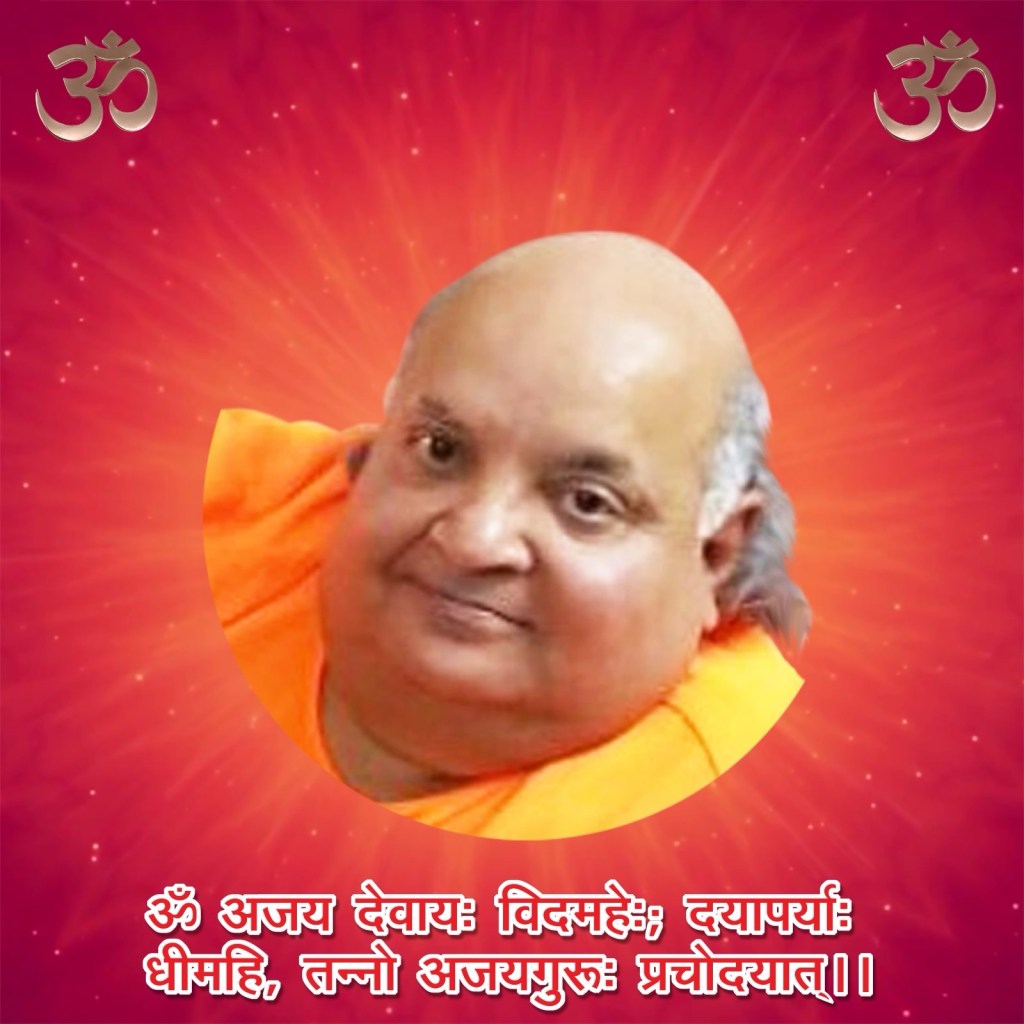
Swami ji’s Sandesh… “हर त्यौहार हमें ‘उत्साह’ और ‘ऊर्जा’ से जुड़े रहने की प्रेरणा देता है…”

Swami ji said…

Festive fervour is palpable and discernible during all festivals. Cheer and a celebratory spirit prevail in the air, as the energy, enthusiasm, and excitement with which everyone plans to welcome and celebrate the festival radiates through them. And why should it not be this way ?
“त्यौहार का एक अर्थ ऊर्जा और उत्साह ही होता है…हमें यह समझ जाना चाहिए कि जब हम त्योहार मनाते हैं, तो हम ऊर्जा, उत्साह और उमंग से भर जाते हैं…”

If we fine-tune our senses, we will be able to realise and experience the divine embrace in which He seems to hold everything around us, exuding ‘spiritual’ energy in a very special way – during the days of a festival, thereby,
providing us with that extra energy that each one of us needs – to stay connected with Him – as we plan and prepare – for the day to arrive.

Beaming, cheerful faces are a welcome change for all to behold, replacing the tired, jaded, faded faces that we see regularly. A bounce in our stride hides the tiredness we experience while scrubbing and polishing every nook and corner of our homes. Exhaustion and fatigue turn into unknown, alien emotions during the period preceding the glory and greatness of God. Lethargy and laziness — so regular a feature on ordinary days — are replaced by quickness and lively movements.
It could be any festival, in any part of the world.
Elaborate plans are made enthusiastically to celebrate. Happy, excited faces fill our surroundings – radiating an inner glow and radiance – which unfortunately we allow to extinguish once the festival has been celebrated.

Energy, as we know, can never be destroyed. It is only transferred. It changes form — from positive to negative, or from negative to positive. Thus, negative energy must be replaced immediately by positive energy. Festivals give us that very opportunity — to renew our energy, refresh our hearts, and reconnect with the divine source of all joy.

Have we ever questioned ourselves — When we are capable of exhibiting such a high level of energy and enthusiasm during festivals, why are we then unable to display the same cheerfulness on ordinary days? What makes us so lacklustre and dull on regular days? In order to find an answer to this question of ours – we do not have to look very far to keep ourselves motivated, energetic, and enthusiastic. Just look at a child — ever curious, ever active, and always ready to explore, without the burden of yesterday or the worry of tomorrow. It is said that a child filled with energy can easily engage and hold the attention of sixteen people, drawing them in to placate, pamper and meet his needs and demands.
Just like a child who becomes joyful with the simplest of things, we too should be filled with ‘utsah’ and ‘umang’ throughout – undisturbed and unaffected by all that happens around us.
Unfortunately, the childlike exuberance becomes a trait of the past, and, instead, we prefer to settle for unhappiness, pessimism and negativity. Have we ever wondered – Why do we let positive energy drain away from our ‘selfs’ at the first sight of a storm building on the horizon and allow it to plummet to the lowest realms of negativity? An age-old practice of whitewashing our homes during the festival of Deepawali ensured a clean, spick and span exterior. But, what is of greater significance, today – is to extend that cleansing to the inner walls of our mind and heart as well. For what use is a spotless home, if, the mind remains cluttered with resentment, envy, or , despair? The true radiance of Deepawali is not merely in the lamps we light outside, but, in the one we ignite within — when we sweep away the cobwebs of fear and self-doubt, and allow divine light to enter. It is then that every day – not just the day of the festival, becomes a celebration of renewed energy, purity, and grace.

True renewal begins not with new clothes, sweets, or , lamps — but with a mind renewed in faith, a heart washed of bitterness, and a spirit rekindled with light. Each day, then, becomes its own festival — not marked by noise and decoration, but, by peace, gratitude, and the quiet glow of divine presence within.

Swami ji’s Sandesh … “हमारी हर ‘समस्या’ का ‘समाधान’ ईश्वर के पास है…”

Swami ji said…

Undoubtedly, “सांसारिक जीवन व्यतीत करना आसान नहीं है — क्योंकि बहुत सारी ‘समस्याएँ’ हमारे सामने आती रहती हैं और आती रहेंगी…” We cannot deny this and it is a truth that must be accepted. To visualise a life free of problems — a lifetime devoid of difficulties — would be to live in a fool’s paradise. Merely wishing them away will not achieve the desired results, for the challenges and trials we are destined to face will inevitably find their way to us. It is during such demanding phases that we must remain alert and composed in order to overcome them.

Our elders, with the wisdom born of experience, often say philosophically, “इस बात में दो राय नहीं है कि ‘संसार’ का दूसरा नाम ‘समस्या’ है…”
Yet, sitting helplessly and saying, “I don’t know how to overcome this problem,” serves no purpose and helps no one.

So greatly perturbed and over – wrought are we just thinking again and again about the problem – that we seem to forget that – ” ‘ईश्वर’ के पास हमारी हर समस्या का समाधान होता
है…” Our faith and belief in His divine ability to provide us with solutions – whenever we find ourselves in complex and complicated situations – will always yield miraculous results.

Problems in life often seem unsolvable. The mind is unable to see any relief in the future. All its analysis and foresight fail to find a solution. There appears to be no light at the end of the tunnel. In such moments, one can easily give in to despair, react with anger, or, find fault with everyone and everything around.

But, the spiritual seeker must not yield so easily. He must resign himself to God. He must accept that where he stands now was destined by God, and, where he will reach – is also in His hands. The seeker must continue to act – as instructed by the ‘guru’ — with composure, steadfastness and complete faith in God. He must act with the belief that not only will all be well later, but, that all is well even now – regardless of how things may appear to the world outside.

Only then will he truly experience God by his side. He will realise that he has emerged unscathed, even though the worst has occurred. He will also see that situations once deemed hopeless have miraculously transformed themselves into favourable circumstances. Everywhere he looks, he will witness the divine ‘leela’ of God unfold before his eyes.

Even the greatest souls were not spared from hardship. In the Mahabharata, Kunti prayed to Krishna for difficulties, knowing that suffering deepened her remembrance of Him. In the Ramayana, Lord Rama — the Divine Himself — accepted exile with quiet grace, showing that faith is proved in adversity, not comfort. In the Bible, Christ’s words echo the same truth: “Do not worry about tomorrow, for tomorrow will worry about itself.” Across all faiths, the message is one — God may not remove our burdens, but , He walks beside us through them – showing us ways to make the heavy burden feel lighter. The storms of life come not to drown us, but, to teach us to keep our gaze upon Him – as He alone is our problem solver.

Once we develop unshakeable faith in God’s will – we will become aware of the fact that even when all paths seem closed, God, in fact , has already prepared the one we are meant to walk. When faith deepens, fear dissolves — and every problem, however insurmountable it may appear, quietly begins to reveal its divine purpose.

We need to remember – “जहाँ ईश्वर में श्रद्धा अटल होती है – तो वहाँ समस्या से उत्पन्न हुआ अंधकार भी, श्रद्धा की रोशनी से प्रकाशित हो जाता है ।”

Swami ji’s Sandesh… “ ‘गुरु’ अपने भक्तों के सारे प्रश्नों के उत्तर देते रहते हैं… उनमें उनको सुनने और समझने की क्षमता होनी चाहिए…”

Swami ji said…

The divine relationship that develops between a ‘सच्चा संत’ and a devout ‘भक्त’, a dedicated ‘साधक’, is one that is ordained by the Almighty. For, “वो जो ऊपर नीली छतरी वाला बैठा है , जिसकी इजाज़त के बिना जब एक पत्ता भी नहीं हिला सकता , तो क्या यह संभव है कि ‘गुरु–शिष्य के बीच का दिव्य तार उनकी इच्छा के बिना जुड़ सकता है…?”

From the very moment an enlightened soul rests His eyes upon those ‘lost’ souls who come to Him for His Grace, nothing — absolutely nothing — remains hidden from Him. Their past, present, and future is already known to Him. Yet the wisdom, restraint, and discipline that years of ‘साधना’ have instilled in Him, equip Him to keep that knowledge to Himself. With only a gentle, knowing smile, He carries truths that ordinary individuals like us could neither bear nor accept — the shadows of our past deeds, the obstacles awaiting us in the future, and the trials woven into the present journey of our lives.

Once He accepts a devotee as His own – every joy, burden, and sorrow of that devotee becomes His. He smiles when they smile, and, He feels their pain when they are hurt — even when He is fully aware that such moments of pain were destined to come their way. The devotee may feel hesitant to open the deepest chambers of his heart before their ‘guru’, weighed down by shame or remorse for past misdeeds — but nothing remains hidden from Him. To Him, His devotees are open books. When faced with sudden, overwhelming situations, the devotee naturally feels at sea, unequipped to handle unavoidable developments. It is then that the ‘गुरुदेव’ steps in — beginning a silent, systematic process of guidance. Every thought that stirs in the devotee’s mind is read and deciphered by Him, and, answers are quietly offered by Him to them when their mind is still, away from the noise and clamour of the world…” ‘गुरु’ हर समस्या का समाधान बताते रहते हैं…”

A spiritual seeker must, therefore, cultivate the ability to listen inwardly. For the ‘guru’s’ voice is never absent. It flows ceaselessly in silence. Only when the mind is steady, humble and receptive does one begin to truly hear it.
It is natural to feel fear when untoward developments arise. But even that fear must be turned into an opportunity — a reminder to direct one’s thoughts towards ‘guru’ and God.

The spiritual seeker, especially, must make this a practice. Trials and tribulations come to all; no one is spared. Yet for the seeker, these very moments become sacred chances to hold on even more firmly to the Guru’s presence. Slowly, they discover that what once seemed ‘uncomfortable’ begins to feel almost comforting. For when the path ahead is unclear to the mind, the awakened soul does not fret — it rests in the certainty that the Teacher has already taken over and is carrying the devotee gently towards safety.
Thus, it becomes important to stop wandering anxiously in search of answers. And yes — this is easier said than done. But to panic and lose composure is only to surrender to our most base instincts in the face of fear. Instead, we must summon the courage to keep our faith alive, steady ourselves, and place every worry at the ‘guru’s’ feet. For when the mind rests in calm trust, even the fiercest storm reveals a path quietly lit by the Guru’s Grace.

Swami ji’s Sandesh… ” ‘कष्ट’ से ही ‘साधना’ उत्पन्न होती है…”

Swami ji said…

“मैंने अपने जीवन में बहुत कष्ट देखे हैं…” “मेरा जीवन कष्ट से भरा है…”
“बहुत मुश्किल से वह कष्ट काटा है मैंने…” This is the din we hear around us, as each of us, tries to, vociferously,
draw attention to our suffering — magnifying the pain we had to endure, highlighting the intensity of the grief and sorrow we experienced — in an evident attempt to make it clear to everyone around us -“मेरे कष्ट से बड़ा,किसी का कष्ट हो ही नहीं सकता…”

But, how are we going to live a lifetime if we allow ourselves to be submerged in such shallow, hollow, self-pitying thoughts? Are we running a race, holding a placard stating the nature of our ‘कष्ट’ – waiting to be declared the proud winner of the coveted title of the person – “जिसका जीवन बहुत कष्टदायी रहा है..”

One can never deny the fact that – “जीवन में कष्ट आयेंगे…” It is not possible for any of us to pass through the number of days, we are destined to live, without ordeals, obstacles, and issues coming our way. But, we have created the biggest problem for ourselves by giving them a larger-than-life importance – by becoming so greatly attached to the ‘कष्ट’ – that we talk about it endlessly, refuse to let it go, and keep reflecting on it regularly — often unaware that – “वह कष्ट, जिसे हम अब भी पकड़े हुए हैं, वह कब का कट चुका है…”

A spiritual seeker must always remember the words said to him by his self-enlightened गुरु – “जो कष्ट आकर कट जाये उसे कष्ट नहीं कहते…” Once a devotee understands the depth of these words, he is able to deal with his difficulties and tackle them in a mature, rational manner. Once he comprehends that -“कष्टों से वह मुँह नहीं मोड़ सकता है…”— for it is his ‘कर्म’ that is at play before him — his attitude towards suffering begins to change. He might not be aware of the divine fact – that his गुरु is able to see the कष्ट long before it arrives at the devotee’s doorstep and in His unfathomable way has already diluted the potent, lethal effect of the suffering that His devotee will have to go through. And, if, the devotee remains calm and steadfastly focused on the teachings of his ‘गुरु’ during hardships, he will realise that the ‘गुरु’ has carried him through the storm miraculously — leaving him with nothing more than a few superficial scratches at best – which he was meant to, destined to bear in this lifetime.

In fact, suffering — which we all fear — too has its benefits. The mind is such that, in good times, it becomes completely lost in enjoyment. There is little incentive to reflect on the ‘soul’, ‘कर्म’, God, or anything spiritual — for the material world holds our senses captive during days of comfort and pleasure. It is only when we suffer, when we look for relief, that we begin to reflect on spiritual matters. For in suffering, it is the ‘senses’ that are in pain — not the ‘soul’. And thus, in suffering, we find solace in the ‘soul’ — for it remains untouched by physical or emotional pain. It is during suffering that we most try to withdraw from the material world and from attachments of every kind.

It is suffering that shows us the importance of recognising the ‘soul’ and the ‘body’ as distinct. It is suffering that forces us to ‘observe ourselves’ as separate from our emotions. We come to realise that even the mind is not the real “us,” and that it is only through controlling the mind that we can truly influence how we feel.

Thus, do not lament about your sufferings of the past — for they are gone and done with – and are now a part of your past. The very fact that you have emerged from them largely unscathed means that your ‘guru’ was right by your side, holding your hand, giving you the strength needed – during all those moments of sickness, disease and difficulties and above all – the benign eye of God. When you see trouble brewing, breathe a sigh of relief — for it is a sign that the worst is about to pass, with the help of God…“जितना कष्ट कट जाये — उतना ही अच्छा है।”

Use the pain of suffering as a reminder to stay on the right side of ‘कर्म’ and to cleanse the mind of the stains left by the material world. Accepting ‘कष्ट’
without lamenting about our ill – luck , our ‘बुरी किस्मत’ ;without complaining as to why are we the ones to suffer over and over again and when we stop playing the victim card – it is only then that we can truly say that we have understood the essence and the core message of the sacred ‘ज्ञान’ that was imparted to us by our ‘गुरु’.

Swami ji’s Sandesh- “हमें बीच-बीच में अपना ‘आत्म-विश्लेषण’ भी ज़रूर करना चाहिए…”

Swami ji said…

One of our favourite passtimes is to ‘talk’ about people we know—or might not even know. We may have just seen them somewhere, yet, we tuck their image away in some corner of our mind. And, then, the moment we recall their face—or the slightly inappropriate manner in which they may have presented themselves before us — we feel qualified to judge them and to give our opinion about them.

We seem to enjoy discussing others, and, at times, even debating about them angrily—especially when we feel that we are not gaining enough support in belittling them. Why is it that we take no time at all to form a one-sided opinion about others and find nothing wrong in making it known to everyone? How we love to analyse others—doing so with single-minded focus—dissecting every action of theirs and every word they speak, as though it were our birthright.

But then why are we—rather hypocritically—so shy, so hesitant, and so weary of being at the receiving end – when others attempt to analyse us? The same ‘we’ who so eagerly record every “unpardonable” act of others in our memory – are quick to produce a hundred excuses when someone voices a negative opinion about us. We defensively say, “That is not what I meant…” or “Normally, I am not like that! Something must have happened that day!”

Have we given ourselves the right to comment freely on others, to think whatever we wish about them, yet deny that same right to anyone else regarding ourselves? Have we vested ourselves with a power -“जो हमें इजाज़त देता है दूसरों पर टिप्पणी करने की, उनके बारे में कुछ भी सोचने का हक़ देता है — परंतु अगर कोई हमारे बारे में कुछ कहे, तो वो हमें बर्दाश्त नहीं होता है…”
When we can be such cowards in accepting the verdict of others—can we truly muster the courage to judge ourselves honestly and critically? “हमें स्वयं का आत्म-निरीक्षण भी तो कभी- कभार कर लेना चाहिए…”

Why do we have such double standards? If we can be so brazenly brave in ‘surveying’ others, why can we not accept an honest analysis about ourselves with the same courage? But, since we have already concluded in our mind that we are perfect in every way, we, tell ourselves that we do not need to undergo any ‘self-analysis’ at all. We conveniently reassure ourselves: “There is nothing wrong with me—why should I reflect?” But, this refusal to examine ourselves keeps us exactly where we are—unchanged, untested, and unevolved.

समय समय पर ‘आत्म-विश्लेषण’ करना — must become our habit. For only when we are honest with ourselves, and, willing to see and hear uncomfortable truths, through our inner voice – about our own actions – do we truly grow. It is always good to question ourselves occasionally – “Am I selfish or selfless ?” “Am I kind to all ?” “Do I stand by others during their difficult days?” “Am I an honest person?” This would be a good way to know where we stand – if we give honest answers.

The true spiritual seeker must maintain constant self-vigil. He must be critical only of himself and his behaviour—for it is only criticism of himself and being conscious of his behaviour, his attitude, his ‘karma’ – and not of others – that will be of any real use to him.

It is only those, who have the courage to see and acknowledge themselves for what they truly are – are the ones closest to taking the next steps towards ‘self-improvement’. Only when we recognize our own faults – can we rid ourselves of them and make ourselves worthy of receiving God’s grace.

Did not Ravan fall prey to such blindness? What did he lack—power, knowledge, strength? And, yet, he was blind to his own weaknesses of nursing a huge ego and senseless pride. It was this blindness that ultimately caused his downfall.

‘Self-reflection’ is the key to gaining control over our ‘कर्म ‘. “स्वयं का आत्म विश्लेषण और ‘आत्म निरीक्षण’ करने से – we become aware of our ‘self ‘, of our actions, conscious of the importance of choosing right over wrong, of forming good habits, not succumbing to desires, of being truthful and honest – all of which shape us into better human beings. This is often – the very first step that takes us towards truly knowing God.