Swami ji’s Sandesh… ” जो कुछ हमारे पास आज, अभी नहीं है – उस में भी ईश्वर की मर्ज़ी है …”

Swami ji said…

In the journey of life, every individual, encounters moments – during which he feels that he lacks something; there is something missing in his life; unfulfilled desires or unanswered prayers. In fact, we always feel that the very thing that we deem ‘essential’ – seems to be missing from our life.

It could be anything. To some, it might be a house in their name; to others, a promotion; and to someone else, finding a life partner. Whatever it is that we lack at any point in time- strangely that very thing seems very essential to us — and without it – we feel as though we are on a slippery slope. We are convinced in a strange way, that doom awaits us, unless this ‘need’ is fulfilled.

But, if, we introspect a little, we will realise that there is no phase in our life in which we ever feel fully fulfilled. The mind always notices something missing — and convinces us that this missing piece is critical – even non-negotiable. And yet — don’t we see the next day? Don’t the problems we anticipate due to our ‘insufficiencies’ rarely ever materialise before us? And even when they do – how is it that the unlikeliest of solutions appear?

Have we ever asked ourselves- How does this happen? Is it due to our own talents and skills only? Definitely not. In such situations, our actions have very little to do with the outcome. The way we are provided for — the way solutions arise — is nothing but the work of God. Yes, we certainly try. But, our ability to stay not just afloat, but even fulfilled – despite shortcomings, has less to do with us and more to do with the miracles of God.

How do people emerge from tragic circumstances? How do some achieve their goals against impossible odds? Yes, they put in effort — but even their strength and resilience is not enough. It is purely God’s will.

The gaps in our life should not make us feel morose or inadequate. They should remind us that we are not in control. We can only act. The fruits of those actions are not ours to command — they are His alone to give.

The spiritual seeker must remember that life’s difficulties are not meant to push him down — but to liberate him from the illusion of control. They are reminders to focus only on right action. There is no point clinging to what we have today, imagining it will be ours forever. It will be ours – only if God wills it to be that way.

Such a perspective brings clarity. We stop worrying and complaining that – ” हमारे पास यह चीज़ नहीं है… वो चीज़ नहीं है…” We realise how foolish we can be by pining for things that just don’t seem to come our way and stop obsessing over fulfilling only our needs. Instead, we begin to focus on what we must do today; do it to the best of our ability and leave the rest to Him. Every opportunity we receive, every person we meet, every idea we have — all are God-sent. They are His way of providing for us. Thus, we must act with sincerity and gratitude and do the best we can with what He has given us.
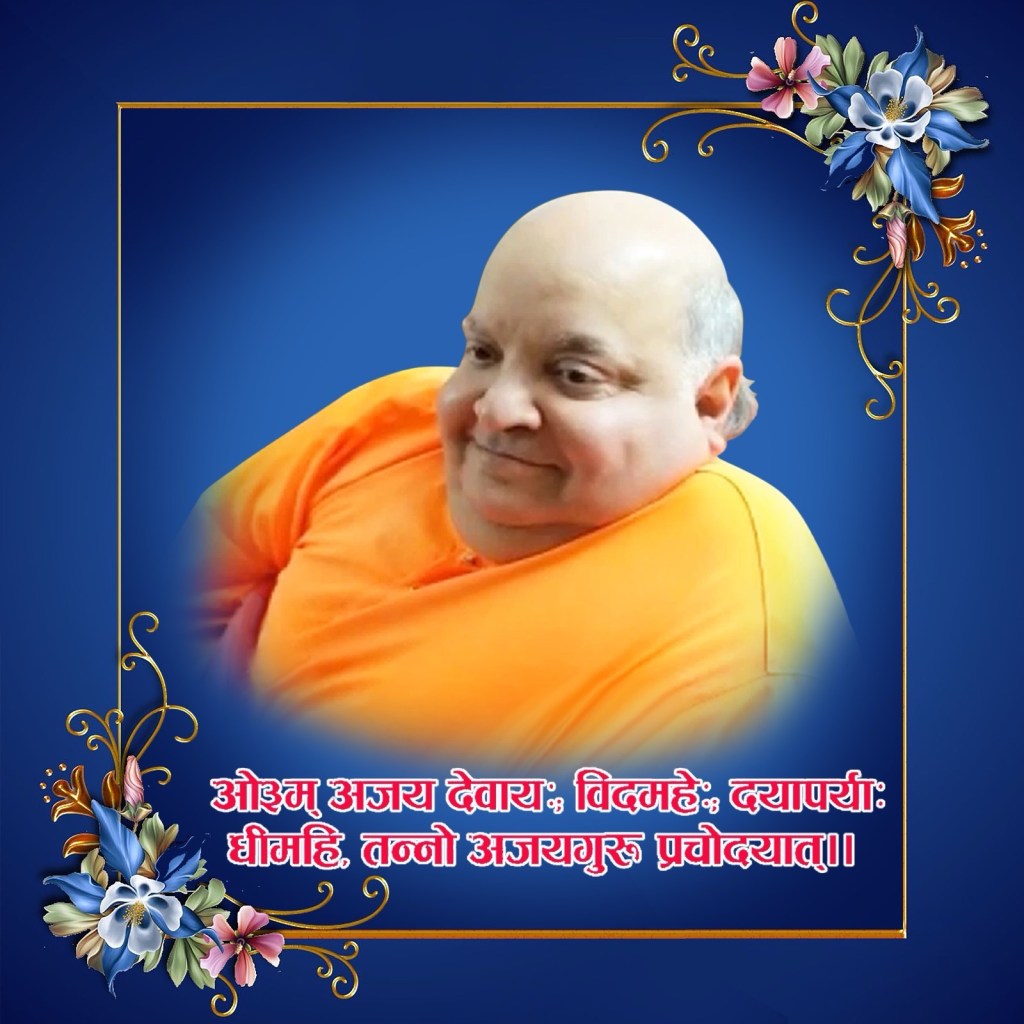
Swami ji’s Sandesh… “हमारा ‘सब्र’ ही हमारे मुश्किल समय में काम आता है…”

Swami ji said…

“I can’t wait for this to happen!” “I can’t wait for this to end!” “How much longer?” More often than not, we hear these expressions from people – hoping that either some uncomfortable or unwanted circumstance will come to an end soon, or , that something desirable and wonderful will happen quick and fast in their lives. In essence, there is always something that we want and are waiting for to happen — something that constantly tugs at our thoughts and mind.

Even in the best of circumstances, man ends up thinking that something will inevitably go wrong, and, he begins to hope to foresee and overcome such problems immediately. He wants to overcome even those problems that are only imaginary – in that very instant; immediately.

Such anxiety and fear will only lead us down a path of depression and sadness. Irrespective of the circumstances—good or bad— we are unable to find a moment of peace. We are unable to savour a single moment of joy, or, even of reflection, because we are never able to appreciate what we have in the present moment.

“Patience is key” – is a phrase we have often heard or been told. But a key to what? It is, in fact, the key to happiness. People often mistake patience for ‘suffering’— for simply bearing whatever they are going through and waiting for things to change. This, however, is a morose description of an otherwise noble trait. What patience truly means is having complete faith in oneself and one’s Creator, and knowing that everything will happen at the ‘right’ time. It means accepting today as it is— humbly and respectfully— without losing sight of where one wishes to be tomorrow. It also means – joyfully accepting that – what one has today is what God feels is enough for him at that moment in time.

Patience is not about waiting. It is a practice of dealing only with the present. It is a practice of focussing more on one’s actions in the present, and, not being preoccupied with what they will yield, or , when they will bear fruit in the future. Our ‘wait’ could last an eternity. The waiting period could try the limits of our patience – but once we develop firm faith in the words – “Sabr ka phal meetha hota hai…” – it is only then that we will understand later as – life unfolds before us – the ‘whys’ and the reasons that had made us wait for ‘that’ certain thing to happen, to be achieved or acquired by us.

The spiritual seeker needs along with personal discipline – a large reservoir of patience – as a foundation for spiritual growth. As he evolves spiritually, he should understand and accept that each belief, each principle, and each teaching that he has absorbed – will be tested by life – at every turn. Yet, the seeker must not react in a manner that is unprincipled or untrue to his faith. He must pause, reflect, and listen within. Oftentimes, he will feel reassured even in the most trying of circumstances. He will be confident that – “This too shall pass.” He will soon realise that patience is the art of surrendering oneself to God — of giving up the urge to control outcomes. He will understand that the practice of patience is not about wasting or whiling away time in the hope of a better tomorrow, but, is rather the art of careful and patient preparation. He is of the firm belief that it is only his patience that will reveal the very reason – behind every wait of his – in his lifetime.

Swami ji’s Sandesh… ” जीवन एक नदी की तरह अपनी ही गति से बहता है…

Swami ji said…

Man has always believed himself to be strong, powerful — almost invincible. He takes pride in having conquered the unimaginable ; whether in the skies, in the depths of the oceans, or across the vastness of the earth. He feels that God has created him to subdue, control, and tame the unconquerable. And, when he greets success — after a few failed attempts — he becomes even more confident of his ability to overpower and establish his dominance over the insurmountable, the unvanquishable.

And, this sense of power slowly becomes woven into his identity, convincing him that ‘life’ itself must bend and shape itself to his will. But, on coming across this ‘one’ obdurate, unbending characteristic
of ‘life’ – he finds himself ill-equipped to handle, and, in a way is taken aback by his inability to control the pace, the speed at which his life flows.

Life can never he tailored to our demands. It is not a machine which can be regulated or controlled by us. We can neither increase or decrease its speed…” जीवन अपनी गति से चलता है…” – moving gently, like a river, carving its own path, unhurried by the world’s impatience. There is great wisdom in the words -” Let life flow.” We could wait an entire lifetime for something exceptional to come our way – but, it just doesn’t happen that way. So, wouldn’t it be better if we accepted and welcomed – ‘what’ comes our way. And value, cherish ‘what’ is with us, stays with us and let go, forget ‘what’ is no longer with us. Yet, how often do we attempt to understand what we are truly meant to do in this lifetime — which itself is so brief and fragile?

Man struggles to accept his life for what it is. The crests and troughs of life leave him uncertain, feeling helpless and fearful. The uncertainty makes him despair. He is forever living in the future, trying to guess what tomorrow will bring, hoping to avoid any bumps ahead. But, this is not the way life is to be lived. It is not to be lived in fear. Yes, there will be struggles in life, and , there will be pain. But, we have also been given strength and endurance to overcome them. We must live life being keenly aware of the moment. We must focus on what needs our attention ‘now’. Anything beyond that is wasted effort.

Not all days are meant to be the same. Make the most of each. Display your heart and courage in the dark days and kindness and benevolence in the good days. Each day calls for us to display different aspects of ourselves. Some need discipline, some need joy; some need seriousness, and others need lightness. All, however, must be met with equal effort. That is all that is demanded of us. Life can be enjoyed to the fullest when we accept that – ‘ जीवन को उसकी गति से बहने दो…”

Life unfolds with divine care. The sparrow does not force tomorrow, and the flower does not rush its bloom — yet both are held in God’s protection. Then why should we, who have been given the gift of awareness and faith, live in fear of days yet to come? To live each day with trust — without the burden of anxious expectation — is itself an act of worship. It is to recognise the divine hand that guides every step of ours – at an unhurried pace – even when the path ahead seems unclear to us – but is seen clearly by Him – as He knows that it is most suitable for us.

Swami ji’s Sandesh… “ हम अपने आपको जानना, समझना और सँभालना कब सीखेंगे…?”

Swami ji said…

“My daughter is an MBA…” “My son has graduated from a top Business Management School…” The unmistakable tinge of pride that underlines the voices of parents is too evident to be missed – when they announce to their family and friends that their children have received business-management degrees from coveted institutions. After all, their children are now the ‘best’, the ‘experts’, well-versed in the intricate, nuanced skills of managing business anywhere in the world. No expense is spared in ensuring that their offspring receive the finest, most in-depth training in business management, and, carve a place for themselves in the elite list of the most sought-after Chief Executive Officers in the professional world. Their cup of happiness overflows as they bask in the warmth of the secure future that they are certain awaits their children in the glittering galaxy of professional stars rising to shine.

Of course, it is excellent to be proficient in the management skills that our profession requires — but do we, even once in a while, try to analyse whether we have been able to ‘manage’ ourselves, and our personal lives well enough – on a day-to-day basis? “I am not good at managing myself during times of financial difficulty… I am tempted to give up my values and principles of honesty…” — we admit sheepishly.
“जब हम ‘आर्थिक कठिनाइयों’ से घिर जाते हैं, तब क्या हमें ईमानदार रहना मुश्किल लगता है?”

Has the wealth we have managed to accumulate over the years turned us into proud, arrogant individuals, or, have we retained the simplicity and groundedness we once possessed? Are we able to remind ourselves to stay cool , calm and collected – even though we are well – known for being short -tempered? “क्या हम अपने ग़ुस्से पर क़ाबू पाकर अपने आप को शांत रहने की सलाह देते हैं और कोशिश करते हैं? ” It is here that the true test of life-management lies.

No prestigious school teaches us this. No degree certifies it. This is the syllabus of life — and the only real ‘management’ that ultimately matters. How we manage our emotions, and our reactions to them — is that not what life really is about? Life’s journey takes us through countless ups and down. At times it is dull and monotonous ; at other times- deeply uncertain. All these elicit different feelings and thoughts within us. How we ‘manage’ these and act in a way that is correct – is what matters.

This is the struggle of the spiritual seeker too. When life is riddled with hardships, it is very easy to look up to God and ask for His blessings. But, when life becomes a bed of roses, one finds that devoting even a few minutes to God becomes a monumental effort. In difficult times, man focuses on God’s mercy — pleading to be relieved of his sufferings. He acknowledges that his efforts against destiny are futile and that everything lies in God’s hands. Yet, the moment he begins living his best life, man convinces himself that he alone is the reason for all the good things that have come to him. He is unable to ‘manage’ his ego — his inflated self-worth.

The Ramayana teaches us how Lord Ram conducted Himself, and governed His emotions, even in the most extreme circumstances. He showed that it was not the crown, not the kingship — but rather His composure, discipline, and unwavering morality that made Him the greatest among men. To act righteously even when wronged by one’s own; to hold steadfastly to one’s principles when the rest of the world abandons theirs; to not complain but adapt with dignity to sudden and extreme changes in circumstance — is this not the finest example of managing oneself , the mind, and all the turbulence it brings?

Meditation. Self-reflection. Daily, earnest prayer. These are the tools that help us maintain a vigil over the mind and preserve the purity of our actions. They help us overcome impulses that lead us astray, and protect us from facing their consequences later in life.

Swami ji’s Sandesh… ” अपने जीवन के उद्देश्य को , लक्ष्य को दुनिया की चमक धमक में खोने मत दो…”

Swami ji said…

Life is filled with opportunities. And, there are some among us who choose to focus on these opportunities, and, give a specific ‘purpose’ to their lives. Once they are crystal clear about it, they are willing to give their cent percent — to fight tooth and nail to realise that purpose. They refuse to flounder and drown in the sea of deceptive distractions. Instead, they stay afloat, remaining committed to the promise they made to their own purpose.

One needs only to be daring enough to attempt the ‘unthinkable’; to be adventurous enough to take risks and test one’s endurance in order to achieve one’s aspiration. Merely dreaming of attaining a lifelong ambition, while making half-hearted attempts that clearly show our lack of sincerity and commitment – can never serve any purpose. At times , when we are questioned by others on not talking much about the ‘purpose’ that we had talked at great length about earlier – and on finding ourselves cornered – we try to pass the blame for not having succeeded ; for having met failure — onto the endless distractions that, in a strange way, always seem to wield greater power over us, and, inexorably pull us away from the very purpose we had set so clearly for our life.

Distractions — loud, unruly, and tempting — find it all too easy to lure us away from the long, tiring hours of hard work and perseverance that we need to and even intend to put in – which seem to die a natural death in the cacophony of distractions. And, just when we are struggling to stay true to our purpose – by trying desperately to pull our senses inwards – “बाहर की चमक धमक से…” – our defences seem to fall , right then and there, and, ‘distractions’ win hands down over our ‘purpose’.

The hold of our purpose should be so strong and firm over us that in the tug – of – war that ensues between our purpose and distractions – our purpose stands ground without giving an inch to the bewitching lights of distractions. Rather we should know when to hold our distractions at abeyance – and let them know that our purpose holds more meaning for us than the inviting diversions.

All of us yearn to hold powerful positions, earn a king’s fortune. A few among us, blessed with a vivid imagination and a strong will, are able to shape these dreams into a clear vision for their life. But that vision can bear fruit only when it is guarded carefully — when we choose, day after day, to let our purpose speak louder than every distraction that calls us away from it.

The world today offers many distractions — entertainment, social media. We can go on and on as the list is endless. Man struggles with these. They nag him, sway his focus, and draw him away from his duties. Many a time, it seems that man wants to be distracted — to escape the effort and struggle needed to remain focused. The mind revels in the pleasure these distractions offer and keeps seeking more. It is these distractions that consume his time, quietly stealing away the hours that could have been dedicated to his purpose.

The spiritual seeker finds this to be an even greater challenge. God, too, needs our ‘time’ and ‘effort’ if we seek Him from our body, mind and soul. Yes, this is difficult. The mind — always seeking comfort and pleasure, always avoiding restraint and sacrifice — must be reined in again and again. The way to achieve this is to cultivate constant awareness. To remain on guard and bring ourselves back each time we notice that the mind has drifted into indulgence or carelessness. Of course, the mind needs rest, but we must always strive to be its master — never its servant.

Simplicity, both in thought and in life, is one of the surest means of attaining focus and a controlled mind. Those who place too much value on material possessions, who are overly concerned with satisfying the senses, become deeply entangled in the material world. As a result, they require far more effort — and experience far more pain — to steady the mind and turn away from indulgence. But, those who live a life centred not on the ‘senses’, but , on the ‘self’, find it much easier to focus on all that needs to be done to realise God one day.