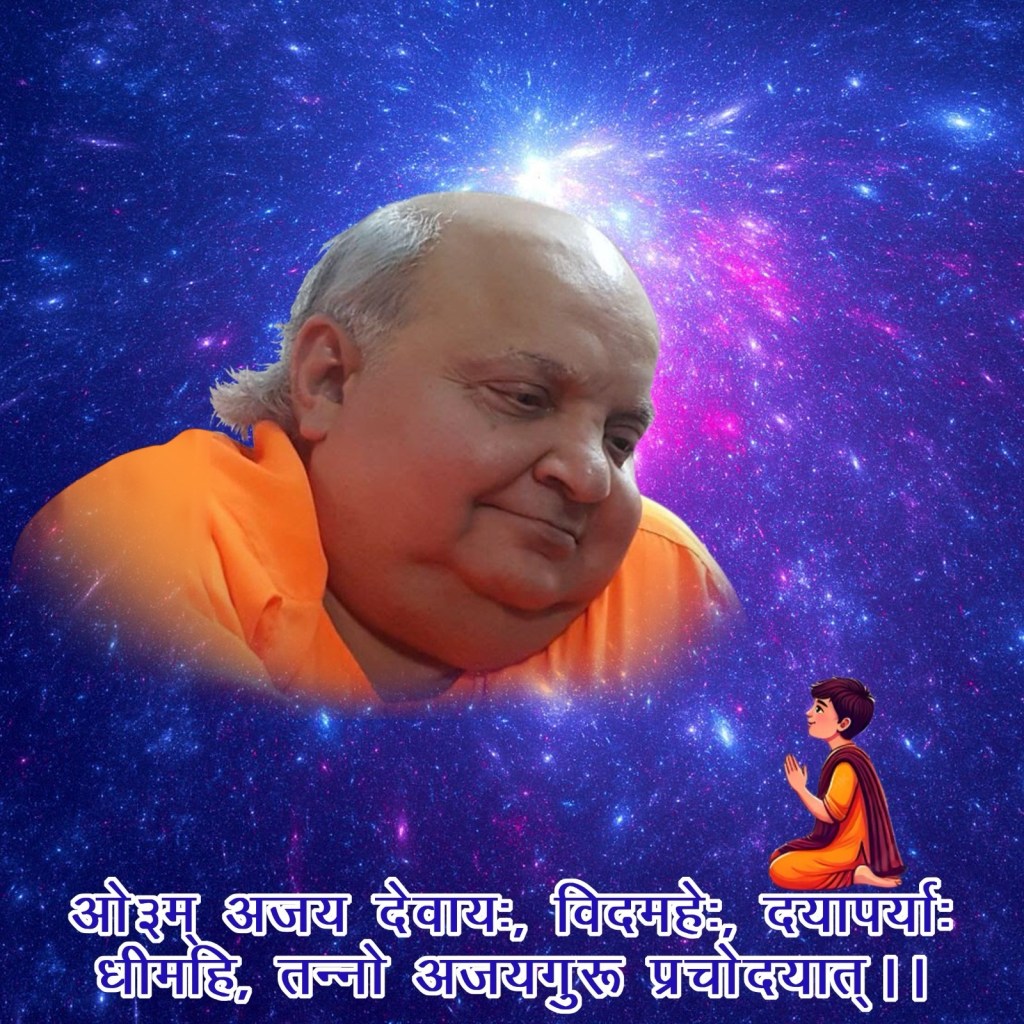
Swami ji’s Sandesh… “ ‘कृतज्ञता’ से भरा हुआ मनुष्य हमेशा प्रसन्न रहता है…”

Swami ji said…

How often do we actually acknowledge those blessed moments in life—unique to each of us—when the heart overflows with gratitude and love for God? For some, they arrive quietly and infrequently; for others, they are a constant companion through life. In such moments, joy radiates naturally from within us. A soft smile graces the face, and an unmistakable lightness enters our step.

If we were to pause and reflect on where we truly stand, which category would we place ourselves in? For many of us, the answer would be uncomfortable: a face weighed down by gloom, brows knitted in constant worry, and tension written unmistakably across our features. Our body language conveys it all.

Uncertainty and anxiety—about what might happen the very next moment, about an unpredictable tomorrow, and the anticipation of a problem-filled future—have stonewalled our hearts, making them heavy and incapable of perceiving the wondrous light that a heart filled with gratitude for God’s ways can feel.

Is it even possible for us to come close to a state of true happiness when the heart is plagued by doubt, misgivings, and negativity? When worry erodes its very core, the heart refuses to see anything worth being happy or thankful for.

There is nothing to be gained by worrying about life.Worrying will not change what is to happen; it will not reduce the suffering that is to come. It will, however, reduce the joy and contentment we can experience today.

It is ironic that we all stress and concern ourselves with things over which we have absolutely no control, yet barely take the time to reflect on and analyse our own actions. We all look up at the heavens, asking for so many things—wealth, health, love, and what not. Yet, how often do we question our own efforts: the hard work needed to gain wealth, the discipline required to maintain good health, and the mental fortitude needed to be a good person in all circumstances? If we focused on these, we would gain immense satisfaction from our actions themselves – and would sleep with a light heart and a clear head.

For the spiritual seeker, gratitude is not limited to the ‘good things’ in life. With time, he learns to be grateful even for the ‘difficult times’, for he realises that these are often the moments that pivot his life for the better.

Thus, it is incorrect to be grateful only for wealth and material gains. A truly grateful person is one who looks at life more deeply. As one begins to see God’s hand behind all that happens, one realises the need to be grateful for life itself. For life, in all its happenings, is a grand play of God, and we must be grateful to be a part of it and to witness it. Life itself is an opportunity for man to realise his own divinity and his connection with God. For this alone, he must remain forever grateful.

Swami ji’s Sandesh… ” अपनी ‘बुद्धि’ का समझदारी से उपयोग करो…”

Swami ji said…

The greatest blessing, the greatest gift that the ‘नीली छतरीवाले’ has bestowed upon us, and endowed us with, is our बुद्धि—the amazing ability with which He has equipped us to think, to reason, to distinguish, and to accept or reject before making any action, before doing karma of any kind. And when we are complimented by others on our intelligence, our wisdom, and the sharp manner in which our mind works, we do not really shy away from taking the entire credit of being bright and brilliant—forgetting, very conveniently, that “पिता परमेश्वर ने हमें उस तीव्र बुद्धि से नवाज़ा है और हमें इस लायक बनाया है कि हमारी अक्ल तेज़ गति से चल सकती है…”

We might have heard of a few cases where an individual—once lauded and referred to for his acumen and agile mind, for doing exceedingly well—at a point in time, is later spoken of in hushed tones, about the downturn his life has taken due to the debatable choices he made in the recent past. Well-wishers are left wondering, filled with sorrow: “What is wrong with him?”
“उसकी अक्ल पर पत्थर पड़ गए हैं क्या?”

It is very possible that we find ourselves at a juncture when we reach a breaking point—caused by personal or professional reasons—when all hope seems lost. The mind becomes numb, refuses to function under pressure and stress, and we feel that we are about to crack. It is at that crucial moment that we must revive the light of the mind, remove all elements of darkness from it, and, with determination, steer it to strengthen us and fortify our willpower to battle any impulsive action that we might be tempted to submit to. Directing the mind to do the right thing at the right time is our paramount duty, as it always plays an integral role in guiding every action of ours—be it right or wrong.

But then again, we come back to the moot point: “How many of us are willing to stay resolute on the ‘straight’ path and miss out on the adrenaline rush that a path with ‘twists’ and ‘turns’ can give us?”
The mind, greatly tempted by the frenzy and hysteria of the never-ending distractions around it, feels that it is meant to lose itself in the pleasures of the world and mistakes them to be the true sources of eternal happiness—not realising that these mirages only provide momentary pleasure.

The mind has to be disciplined, trained to understand that life is not meant to be only enjoyed or indulged in revelry, but to also seek answers to more significant questions, such as:
“What is the purpose of our birth?”
“Do we know who we are?”
“When will we move our awestruck gaze away from the artificial lights of the world and see the beauty of the true, radiant light that illuminates our inner being?”

How many times have we let our ego run riot within us—refusing to accept our mistakes and instead repeating them, deriving some strange satisfaction in doing so? We remain adamant and refuse to change. We see nothing wrong in our age-old habit of getting angry over trivial issues, not accepting the fact that we were wrong, and instead insisting forcefully that we can never be wrong—and therefore must always be right. A few among us may have been fortunate enough to make a fortune, but does that mean
“हमारे अंदर अहंकार भर जाए और हम दूसरों को अपने से छोटा समझने लगें? हमें सही और ग़लत में फर्क लगना बंद हो जाए?” Would not such obnoxious behaviour from our end make people say, “उसका दिमाग़ भ्रष्ट हो गया है? अब वह अपने विवेक का इस्तेमाल ही नहीं करता है?”

In spite of knowing that the mind delivers effective results when it functions calmly, we allow it to become agitated—resulting in zero efficiency. But strange is man and his behaviour, isn’t it? And what he gains by behaving in such an erratic manner is known only to him.

Amidst all the mental chaos and confusion in which we live today, what we need to remember are God’s words:
“मुझसे अगर कुछ माँगना ही है, तो सुबुद्धि माँगो…”

Swami ji’s Sandesh… ” ऐसी ‘दृष्टि’ रखो जो ‘सत्य’ तक ले जाए…”

Swami ji said…

All of us are familiar with the oft-repeated phrase : Is the glass half full or half empty? The answer to this question is often used to determine how one sees life — to gain a glimpse into one’s perspective. Whether a person views life through a ‘positive’ lens or a ‘negative’ one. Ultimately, man tends to break everything down into black and white — what is right and what is wrong. Over time, we all develop our own principles and systems to decide what to do and what not to do.

But merely knowing whether one has an optimistic outlook or one is filled with gloom is not enough. What truly matters is how one arrives at that view. What does one observe in a situation? How deeply does one observe day to day developments in his life ? And how does one finally interpret what is seen? It is this process that shapes perspective. And it is on the basis of this perspective that one performs ‘karma’ in life.

We often hear people advising others to “have a better attitude” or “be more positive.” More often than not, however, what they are suggesting is superficial changes in behaviour. It is folly to appear cheerful in the face of real danger, and even more so to convince oneself positively that there is no danger at all. That is not how life is meant to be lived. Such denial eventually leads to ruin.

What one truly needs is the ability to see beyond the superficial antics of ‘maya’ in life — the ability not merely to react emotionally, but to discern what is actually unfolding. This is where spiritual practice becomes essential.

What do meditation, ‘japa’, self-reflection, and the study of scriptures truly achieve for us? They condition the mind. They train it to perceive what cannot be seen by the two eyes or heard by the two ears.

With God’s Grace – the practising spiritual seeker begins to perceive what is said between words — whether spoken by others or arising within oneself. He learns to sense the truth hidden behind harsh speech, and the deceit concealed in honeyed words. Those on the spiritual path, though not yet enlightened, are granted sufficient light by God to recognise His hand behind the events of this world.
Where others see injustice, the seeker sees a lesson. Where others see loss, he sees release. Where others perceive delay, he recognises divine timing. As a result, his actions become more measured, deliberate, and righteous.

Even one’s own actions are constantly observed. A vigil is maintained over the motivations and emotions that give birth to them. This awareness itself refines conduct. This is the perspective we all need.

Why did Lord Rama agree to strike Bali without confronting him face to face? Though His action appeared to violate the rules of combat of the time, it upheld the higher ‘dharma’ of protecting the oppressed — Sugriva — from the oppressor — Bali. Through this, God demonstrated that moral justice must prevail over rigid formality. While the world may dictate what is right or wrong, one must cultivate one’s own vision — a principled way of seeing — before passing judgment. This alone is true perspective.

It is said that Lord Indra has a hundred eyes and Lord Varuna a thousand. Yet even beyond these – there is One who sees all and knows all. To be truly successful in life, we must strive to move closer to Him with every step. Only then do we begin to see life as it truly is — and develop a divine perspective.

Swami ji’s Sandesh… ” इंसान दोहरा व्यवहार करने वाला, दोमुंहा क्यों बनता जा रहा है?”

Swami ji said…

The alacrity with which man can change his colours can, very often, put a chameleon’s exclusive quality of doing so – to shame. In a day man can change his colours numerous times – as and when it suits him; is advantageous to him. A kind and admiring face for those whom ‘he’ needs; and a cold and uncaring look for those who need ‘him’. One tone for friends, yet another for strangers. One set of values in public, and quite another in private. Sometimes he says what others would like to hear, and sometimes what others simply couldn’t bear to hear. There is no moral rectitude on which his behaviour is anchored. No principle on which the character of his actions is based.

Such a double – faced life, while beneficial to the outwardly life, comes at a huge cost to the soul. The mind is forced to remember who it pretended to be, and where. Words begin to lose their weight and meaning and actions lose their integrity. What is spoken is no longer aligned with what is felt, and what is shown is no longer rooted in truth. Such a life may appear successful on the surface, but, within, it breeds constant restlessness and fear — fear of being exposed, fear of being misunderstood, fear of losing advantage.

The spiritual path, however, demands simplicity and honesty in man’s conduct in society. The spiritual seeker must strive to be the same person everywhere: in gain and in loss, in praise and in criticism, before the world and also in solitude. Yes, one cannot be made a fool by being taken advantage of. That is just as necessary. It is sometimes necessary to become a lion – to continue to being a soft lamb within – especially when faced with the bullies of the world. But, one must not let the world make us lose our inherent softness and goodness.

Do we ever see babies and toddlers differentiate between people on the basis of class, looks, colour, money etc.? It is society that teaches them about differences, and, further teaches them to treat everyone ‘differently’. And yes, while there is a pragmatic logic to this, one must still seek to see all as equal and behave with them in an equitable manner as much as possible.

A smile does not cost us money. A hearty laugh will not rob us of our dreams. They can be shared with one and all.
It is only when behaviour is consistent – that the mind becomes steady.There is no burden of pretence to carry, no role to remember, no mask to protect.True strength lies not in adapting oneself to every situation for benefit, but, in remaining rooted in truth – regardless of circumstance. The one who speaks honestly need not remember his words. The one who acts sincerely need not justify his actions. Such a person walks lightly through life, unburdened by inner conflict.

God does not look at appearances, He does not pay heed to lip service. He only looks at intent. He does not measure how convincingly and articulately we perform before others, but, only observes how truthfully we live within ourselves. He wants us to show courage to be truthful – when falsehood is rewarding, and be humble where our pride is bursting for praise. It is when man shows such discipline that the ‘soul’ finds rest.

Swami ji’s Sandesh… “ ‘कामयाबी’ हमें झुकना क्यों भुला देती है ? ”

Swami ji said…

Man strives to be successful. He wants to win in life. And for this he works hard, makes sacrifices, and endures countless struggles. He works and prays – day in and day out – relentlessly, hoping that the Goddess of Fortune will smile upon him, and, when she eventually does, he reaches a place of comfort, recognition and achievement. Yet, somewhere along the path of success, a subtle change begins to take place within him.

When success arrives, it brings with it praise, validation, and attention. The ones who achieve success are listened to more closely and attentively. Their opinions matter and carry a lot more weight. Their presence is acknowledged, and even desired. Life seems great in such times. One feels almost invincible, god – like.

Slowly, but , surely, in such a mindset, the weeds of ego find fertile ground to grow and flourish. We must put an end to this egoistical pattern of behaviour the very minute we find the first signs of it while interacting with others.

“कामयाब होते ही हम दूसरों से इज़्ज़त से बात करना, उनका आदर सत्कार करना, उनकी बातों को महत्व देना- क्यों भूल जाते हैं? क्या हमारी कामयाबी हमारे सर चढ़ जाती है?” The same person who once bowed in gratitude for life’s small mercies, now begins to believe that everything achieved by him was solely due to his personal
brilliance and effort. The humility that came naturally in the times of struggle gradually vanishes. Earlier, one would remember God; seek His guidance, and acknowledge one’s limitations. But when success settles in, remembrance fades.
Gratitude weakens. Instead of looking up to the heavens for guidance, man begins to look down upon his brethren with superiority.

This is where the real danger lies. Success itself is not the problem. Pride born out of it is. When achievement makes us forget the hands that lifted us, the grace that protected us, and the lessons that shaped us – success begins to hollow us from within.

The spiritual seeker must understand that success is not a destination — it is a responsibility. Be it in the spiritual or material realm, the same law follows – ‘The higher one rises…the deeper one must bow’. It is imperative to internalise that every achievement is temporary, every position is borrowed, and every penny can be taken away as easily as it was given. One must beware of getting heady on his success. For those on the spiritual path – ‘success’ in this world – is often the ultimate test. It is a test of his character ; his temperament ; his will – power ; his inner strength ; a test of his belief in his spiritual principles and faith in his ‘guru’s’ teachings. The difficulty of hard times is often a great motivator to push one towards God.
But, the comforts that come with success – are often the wet sand that trap the mind, making every step toward God – all the more heavy and difficult. In such times, one needs even greater perseverance and fortitude to not sway from the path of enlightenment.

Humility, thus, is not to be mistaken for weakness. It is strength under control. It is awareness. It is the quiet understanding that whatever we are today, have today – is not because of us at all, but a result of divine will. Those who remain humble in success stay connected to ‘reality’. They become kinder and softer than before. They speak with gentleness and act with caution – lest they come across as arrogant and narcissistic. They realise that they have been blessed with God’s grace and know that every action of theirs is a reflection of their gratitude at receiving every little thing from Him.