Swami ji said:
“The difficulties of life are too much for me to handle.” “I am unable to meet the never-ending demands of life.” “Life is challenging.” “Why is life so stressful? It places a lot of pressure on me…” These are expressions that have become rather common, and, nearly everyone seems to utter them nowadays —often with a tone of finality and certainty in their voice, as though discouraging any objection or contradiction from those – who are willing to listen to their woeful tale. Instead, they seem to expect others to nod in agreement with their ‘philosophical’, ‘stress causing’ take on life. Does it not appear as though it has become fashionable to express our so-called expert views on life as being ‘stressful’?
“परंतु हम अगर आराम से, शांति से सोचें—क्या जीवन सचमुच में इतना मुश्किल है—तो शायद बहुत मंथन के बाद हम इस निर्णय पर पहुँच सकते हैं…”
We might, after some introspection and quiet deliberation, arrive at the conclusion that—”जीवन वास्तव में इतना मुश्किल नहीं है जितना हमने, हमारी सोच ने उसे चुनौतीपूर्ण, हमें तनाव देने का कारण बना लिया है…”
But the interesting question that arises then is: ” How many of us are willing to hold ourselves, our mindset, and our negative way of thinking – responsible for labelling life as ‘stressful’?”
Life is always the ‘culprit’ in the blame game that is played by us – while we cast ourselves as innocent ‘victims’— always at the mercy of the vagaries of life. Not for a moment do we pause to ponder—”हम जीवन में सब कुछ हासिल करने के लिए इतनी जल्दी में क्यों रहते हैं?”
Do we not add to our stress levels by being unreasonable in many life situations? Take, for instance, our grandiose dreams. Do we ask ourselves whether we are capable of fulfilling all of them? Of realising them one after another? And if we are unable to, we fall into depression. It is good to dream—as long as our dreams are realistic. But what is the use of dreams—”जो हमारा सुख, चैन और मन की शांति ले लेते हैं aur Ishwar se dur le jaate hain…”
Then again, the goals that we set for ourselves— do we weigh them, and, ourselves, on a fair scale to determine whether we are competent enough to achieve them or not ? ” Aur जब हम उन्हें पूरा होता हुआ नहीं देखते हैं, तो हम दुखी और चिढ़-चिढ़े हो जाते हैं…”
At times , some of us could be living a lifestyle that could be beyond our means — but even then do we pause to reflect whether we can truly afford such luxury, or, are we doing so merely to project a ‘wealthy’ image to others? The question – “How and by when can we make more money?” becomes the dominant thought in our minds, thereby causing great tension and agitation to us.
Matters worsen when we begin to compare ourselves with others. The moment we see others doing better than us – our smile vanishes, taking with it our happiness.
Regardless of age, impatience is a trait that seems to persist. We become angry and disturbed when issues related to us – take longer than expected to take a final shape. Somehow, we fail to understand that impatience can never accelerate the realisation of our desires. We wish that everything would happen at the snap of our fingers—quick and fast. And, when it doesn’t happen that way – a needless journey of annoyance and irritation begins – when, otherwise, the same could have been peaceful, joyful days.
The outcome of every situation and moment in life depends on our response—our reaction—and, in a way, our ‘answer’ to it. We must accept and face the difficulties that come our way with patience; only then will things become easier and better for us.
A spiritual seeker must free the mind of frivolous thoughts and theories about how his life is going. There is no point in over-speculating as to why some days seem to demand more of us and others less. We are too small to comprehend the workings of God. Whether the so-called ‘good’ days are truly beneficial for us, or , whether the ‘bad’ days truly harm or exhaust us— we are rarely able to judge in the moment. Only much later in life, through reflection, might we begin to understand.
Thus, the spiritual seeker must remain focussed at all times, training himself to stay calm and not react belligerentlly in any situation. The only thing that he must ensure is that his spiritual beliefs and practices are reflected consistently in his conduct. He must realise that the mind has a tendency to perceive ‘सुख’ as fleeting and ‘दुख’ as prolonged.
A minor setback can be brooded over and exaggerated by the mind for hours, while moments of happiness may vanish quickly from memory in the face of looming uncertainty.
It is only when one learns to remain steady and unaffected by ‘sukh’ and ‘dukh’, treating them as equal and transient, that one truly begins to walk the path of enlightenment.
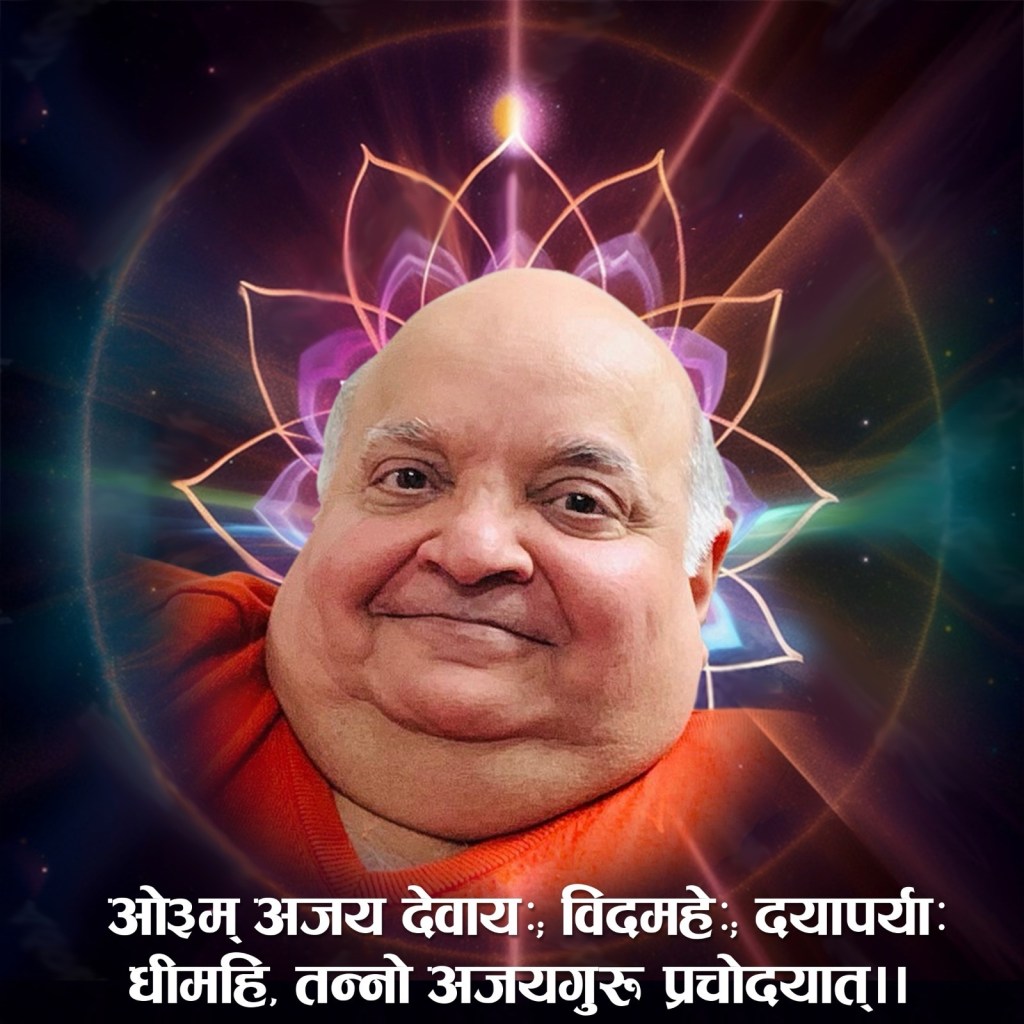
 Dedicated to Swamiji Ajay Jain ji