“Where is the time to hate and judge ? Instead, improve yourself…”

Swami ji’s Sandesh …

Man’s behaviour, very often, is perplexing – almost a paradox. While he can be immensely self-centered at one end, he, also loves to meddle in the lives of others, at the other end. While he always prioritizes himself first ; thinks of his own welfare first; his eyes are always darting here and there and ears are perked up to figure out what others are upto. In some ways, he is neither here nor there – neither is he truly focussed on himself, nor, is he completely immersed in his fellow beings,and, thus, many a times, all he ends up doing is – waste precious time. Such is the sad story of many lives that have ended – and unfortunately could be the same – of even those who are yet to come.

समय अमूल्य है – Time is invaluable. And there is only a limited amount of time to achieve what we want to truly accomplish. At its core, any success or achievement is the result of a constant struggle to be better.The more we struggle the better we turn out to be and greater is our success. Thus, we need to understand that most of our time should be utilised, in improving ourselves. Unfortunately, that is rarely the case.

People idle away time – gossiping, passing judgement, criticizing and finding faults with others. Many entertain themselves with television shows that popularize such behaviour. Social media encourages us to keep an eye on what our friends are upto. We indulge ourselves merrily in these activities and fail to discern that most of the time – there is no emphasis on ‘reflection’ and ‘self-improvement’ – in all that we do. Our time is constantly spent on the ‘external’ – on other people and other events. How can we then hope to truly improve ourselves ! How can we expect to be truly exceptional at anything ?

We must look at those – who , according to us , are successful. Do they appear to be involved with what others are up to ? Do they seem inclined to express opinions on that which does not concern them ? A closer look will reveal that successful individuals are unable to find that extra time – to waste it – in gossiping, hating , judging or criticising others, but, focus all their energy on improving themselves – their lives.They realise that time is valuable and the best would be to direct their attention towards their aim and ambition. They have a fire within them to do something worthwhile – that makes them want to improve all the time. Such is the attitude that we too need to develop.

Cherish this lifetime. Value it. Add further meaning to it ; a few more dimensions. Be passionate about improving every aspect of your life. Become so involved in bettering yourself as an individual – in strengthening your weaknesses – converting your handicaps into citations – your odes into celebrations – that you do not find time to talk ill of others. Hours that could be utilised by us to improve ourselves ; work on our incompetencies – are instead whiled away nearly everyday by back biting ; directing all our energies on hating certain people we dislike. Do we ever realise that …” Hum doosron ki burai karke , unke ‘karma’ bhi hum apne upar le lete hain ?’ The minute someone projects disagreement with us, we enter into a verbal conflict with him – are willing to face rounds of verbal duels without accepting defeat. What do we gain by such a clash of egos’ ? Precious time is lost in such petty behavior.

We must question ourselves regularly – whether we are making the best use of time or not. Even the random thoughts that arise in the mind are actually a waste of time. Why not strive to control them and centre them on God? Why indulge the mind by thinking about things that least concern us? Why waste time thinking about the future or the past, when we can collect our thoughts and focus our mind on God. A single moment, filled with the thought of God ; filled with thoughts of self-improvement – is time that has been utilised to its fullest.

If we truly are miserly about anything – then it should be about ‘time’ – the manner in which we spend it. Is it effective and efficient? Time must be used for development of the mind, body and soul. If we are greedy for anything at all – it should be only for more time – time that can be utilised to improve ourselves. To truly utilize our time well, we must raise self-awareness through meditation and self-reflection. We must be mindful of what we are doing at any time – and double check whether we are using time judiciously. With practice, we will slowly but surely, become masters of our destiny – as we will develop the skills needed to utilise time for our optimal growth.

Where is the time to hate…

Swami ji’s Sandesh …

Man’s behaviour, very often, is perplexing – almost a paradox. While he can be immensely self-centered at one end, he, also loves to meddle in the lives of others, at the other end. While he always prioritizes himself first ; thinks of his own welfare first; his eyes are always darting here and there and ears are perked up to figure out what others are upto. In some ways, he is neither here nor there – neither is he truly focussed on himself, nor, is he completely immersed in his fellow beings,and, thus, many a times, all he ends up doing is – waste precious time. Such is the sad story of many lives that have ended – and unfortunately could be the same – of even those who are yet to come.

समय अमूल्य है – Time is invaulable. And there is only a limited amount of time to achieve what we want to truly accomplish. At its core, any success or achievement is the result of a constant struggle to be better.The more we struggle the better we turn out to be and greater is our success. Thus, we need to understand that most of our time should be utilised, in improving ourselves. Unfortunately, that is rarely the case.

People idle away time – gossiping, passing judgement, criticizing and finding faults with others. Many entertain themselves with television shows that popularize such behaviour. Social media encourages us to keep an eye on what our friends are upto. We indulge ourselves merrily in these activities and fail to discern that most of the time – there is no emphasis on ‘reflection’ and ‘self-improvement’ – in all that we do. Our time is constantly spent on the ‘external’ – on other people and other events. How can we then hope to truly improve ourselves ! How can we expect to be truly exceptional at anything ?

We must look at those – who , according to us , are successful. Do they appear to be involved with what others are up to ? Do they seem inclined to express opinions on that which does not concern them ? A closer look will reveal that successful individuals are unable to find that extra time – to waste it – in gossiping, hating , judging or criticising others, but, focus all their energy on improving themselves – their lives.They realise that time is valuable and the best would be to direct their attention towards their aim and ambition. They have a fire within them to do something worthwhile – that makes them want to improve all the time. Such is the attitude that we too need to develop.

Cherish this lifetime. Value it. Add further meaning to it ; a few more dimensions. Be passionate about improving every aspect of your life. Become so involved in bettering yourself as an individual – in strengthening your weaknesses – converting your handicaps into citations – your odes into celebrations – that you do not find time to talk ill of others. Hours that could be utilised by us to improve ourselves ; work on our incompetencies – are instead whiled away nearly everyday by back biting ; directing all our energies on hating certain people we dislike. Do we ever realise that …” Hum doosron ki burai karke , unke ‘karma’ bhi hum apne upar le lete hain ?’ The minute someone projects disagreement with us, we enter into a verbal conflict with him – are willing to face rounds of verbal duels without accepting defeat. What do we gain by such a clash of egos’ ? Precious time is lost in such petty behavior.

We must question ourselves regularly – whether we are making the best use of time or not. Even the random thoughts that arise in the mind are actually a waste of time. Why not strive to control them and centre them on God? Why indulge the mind by thinking about things that least concern us? Why waste time thinking about the future or the past, when we can collect our thoughts and focus our mind on God. A single moment, filled with the thought of God ; filled with thoughts of self-improvement – is time that has been utilised to its fullest.

If we truly are miserly about anything – then it should be about ‘time’ – the manner in which we spend it. Is it effective and efficient? Time must be used for development of the mind, body and soul. If we are greedy for anything at all – it should be only for more time – time that can be utilised to improve ourselves. To truly utilize our time well, we must raise self-awareness through meditation and self-reflection. We must be mindful of what we are doing at any time – and double check whether we are using time judiciously. With practice, we will slowly but surely, become masters of our destiny – as we will develop the skills needed to utilise time for our optimal growth.
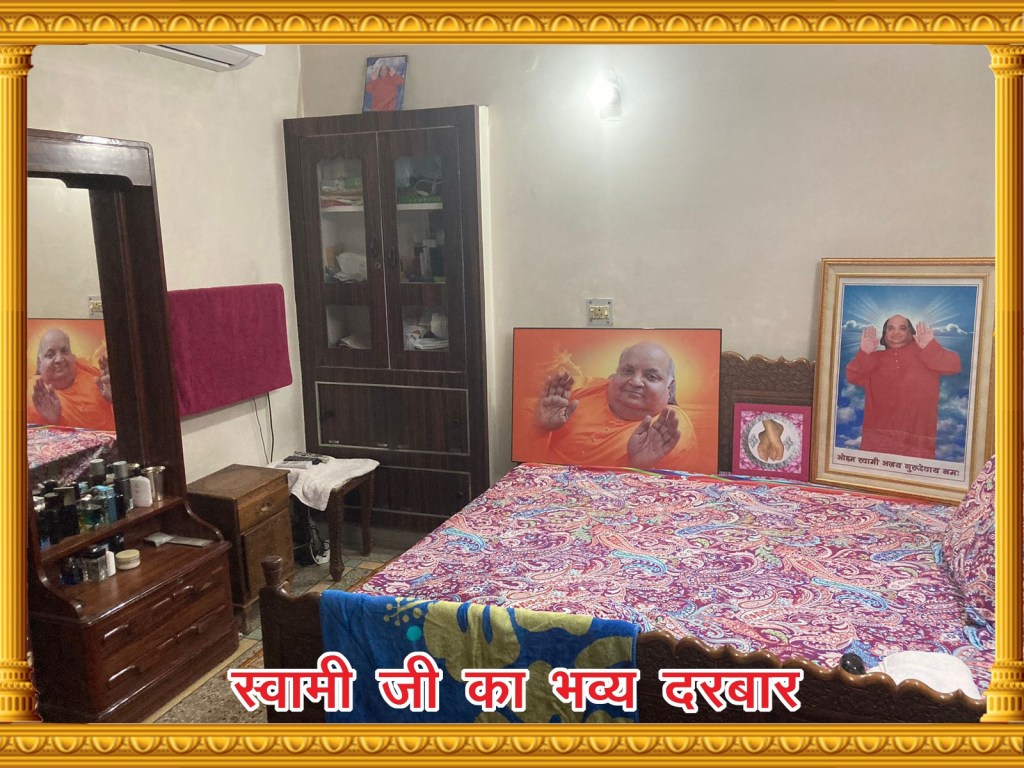
” ‘तुलना’ के खेल में मत उलझो …”

Swami ji said …

The joy and happiness that had filled our heart when we had finally received the toy that we had longed for as a child ; secured a bicycle as an adolescent ; bought a car or a house as an adult – is an emotion that we find very difficult to forget. We believe that life has blessed us with something that we not only desired but also needed. There is sincere appreciation for what we had and have managed to obtain. A child finds joy in playing with a toy for the first time, treating it with love and care. We feel that our daily commutes are much easier when we travel in our own vehicle. We feel a sense of empowerment when we are able to afford a holiday on our own, and , feel a sense of accomplishment when we buy our own house.

Yet, sadly, this contentment is short lived. The mind, over time, starts looking at what others around us possess and shortly comparison replaces contentment; and envy and angst replace thankfulness – and our happiness is short – lived. And, gradually, what we have – becomes irrelevant and what we don’t possess – begins to haunt our minds.

We begin to compare ourselves and our conditions with those of others. The mind is gleeful when we feel we are better off than others , and , seethes with jealousy on seeing those better off than us. There is no peace, and , the mind constantly flip flops in this extreme state – causing us unnecessary stress and tension.
Comparison, thus, not only kills all joy, but, needlessly also lowers our self esteem too. We need to put an end to this game of comparison that we love to play all the time – unless it inspires us to emulate the values and principles of others and become better and nobler version of ourselves.

We perhaps do not even realize it, but , the mind constantly assesses and compares us with others – our standing in society – as compared to where others stand. And while we might not be able to subdue such a thought process altogether, it becomes important for us to remain detached from the chaos it churns within us and stay unaffected by it. We need to put an end to this habit of constantly comparing between any two things that we see or visualise – be it day and night , salt and pepper , summer or winter – between children, between siblings. ‘ आनंद और अपनापन खत्म होता है…jab hum tulna karte hain bacchon ke beech mein, rishtedaaron ke beech mein.’

The best way to achieve this is by focusing on our own journey of life – rather than being consumed by what is going on in the other person’s life – his meteoric rise – his newly acquired wealth and status in society. We must cherish every little blessing that God has gifted us with and take joy in drawing out the most from those precious gifts – to our advantage. We must recognise that all that we have been given – is most suited for us, and, only when deemed fit by Him – shall we receive something else.

Yes, it is important to aspire in life – for a better career, more wealth, better health etc., and , it is only by observing others can we learn to aspire for more. But we must ensure that this does not lead to envy and stress. We must dream, and chase those dreams – but at the same time we must appreciate – that what we have in our life is what God expects us to utilize in furthering ourselves.

Does a ‘saccha sant’ , a self realised ‘ guru ‘ ever draw a comparison between his devotees ? He loves his devotees in equal measure and showers his Grace equally on each devotee of his without expecting anything in return from them. He understands the uniqueness of each devotee and accepts the differences – gifted to them by God – with open arms. Nothing matters to a ‘sadguru’ – neither his devotees’ status nor possessions ! All that matters to Him is the devotee’s eagerness to seek liberation from the cycle of birth and death and merge with Him and God.

” ‘पुण्य’ करने का अहंकार कभी मत करो…”

Swami ji said…

The laws of ‘karma’ -कर्म – are understood intrinsically by most of us. We all generally accept that there is a certain truth to the fact that our ‘karma’ comes back to us. The fruits our actions bear – are most certainly received by us – sometimes instantly, sometimes over lifetimes.
It is this belief that often stops us from indulging in any wrongdoing – ‘पाप’ – and sometimes even inspires a few , and, compels others to do some good – ‘पुण्य’.

It is thus but natural that most of us try to do good ‘karma’ – good actions. Sometimes, it could be simply because we happen to be good hearted individuals ; sometimes in the hope of receiving special blessings from God; and sometimes to be ‘seen’ and ‘perceived’ as a good doer – even if within hearts of hearts we’d rather not – as we try to figure out – what would we ‘gain’ by being charitable. ‘ ‘Galat kaam’ ya ‘paap’ karte huey toh hum ek baar bhi achcha bura nahi sochte hain, toh punya karte samay hum kis soch vichar mein pad jaate hain ?’
Despite the sometimes questionable intentions behind our ‘punya’ – it is still better that people perform good ‘karma’ instead of bad or wrongful actions. However, our intent always has an effect on the nature of our actions, and, the results of good actions will continuously depreciate if the intent behind them is not equally noble.

It is thus important for us to realise that performing good karma’ is a ‘duty’ – something that should be spontaneous and done from our heart. Just like breathing air, drinking water or eating food is essential to the human body; performing good ‘ karma’ is essential for the human soul. Bad ‘karma’ holds us back, while good ‘karma’ frees us from this world. We ultimately owe it to ourselves – to free ourselves from the cycle of rebirth. We are not doing anyone any favours – but to ourselves – by trying to do good.

Why then do some of us feel superior when we perform a good act ? Why do we look down on the less fortunate with an air of superiority and make them feel insignificant and small with our looks and gestures ? Would ‘पुण्य’ – laced with pretence, lack of sympathy and genuine empathy mean anything at all ? The worst part is when we make a big hullabaloo about the acts of charity that have been done by us. Some of us are able to count on our fingertips the acts of goodness that we have done so far. It appears as though we expect to get something in return by doing the ‘पुण्य’ that we intend to do. Like a wealthy man showing off his wealth to those less fortunate; we also boast to others about how magnanimously we have acted – trying to make them also feel small in front of us. What difference then have we truly made to ourselves and to the world ? Doing good ‘karma’ is a blessing in itself – for it is the opportunity to do God’s work – on His behalf – in this world. We should simply be thankful that there was good meaning and a positive intent to, at least, some of our actions during our lifetime.

In His Sermon on the Mount, Jesus Christ, said – ‘ Let not thy left hand know what thy right hand doeth.’ We must take this message to heart and follow it in principle.There is no need to announce to the world the number of good deeds that have been done by us. We must strive to overcome the need to seek admiration from the world for our ‘goodness’. This will be the first step in learning to lose the sense of false pride – the ‘ego’ that we develop – in doing ‘पुण्य’. We will gradually learn to enjoy good ‘karma’ – as the beauty of doing so touches our heart and makes us see Him in every one around us. We will realise that doing good – is the best for us – as it cleanses our soul and makes us feel pure – and that is solely why we should try to be helpful, kind or generous in the first place. And, when it comes to others – we will realise that it is not by admonishing them or by belittling them, but , by showing them the way silently with our actions – can we also stir their hearts into doing good. Our genuine joy and contentment in doing some ‘पुण्य’ will inspire them, too, to do good deeds before it is too late. Remember – ‘ Desist from doing bad ‘karma’ as it is wrong to do so – but nothing can be worse – ‘अगर पुण्य करते समय हमारे भीतर अहंकार की भावना जाग जाती है…’

” Remain calm in all situations… If you try , you will …”

Swami ji said…

Most of us find it a challenge to remain calm, composed and collected during moments of stress, difficulties and unexpected, disconcerting developments – and the blame game begins from the moment we stop being calm. We lay the onus on someone else or something else for making us lose our calm and composure. It is always easy to hold something else responsible for affecting us adversely ; why something irks us or distracts us – and makes us agitated and lose our focus. When we struggle with something – a difficult task or some other complicated issue – we often become snappy and crib about how things are not working in our favour, or , how unlucky we are. In times of struggle a sour, discomforting side of our personality is revealed.

Life as we know loves to throw curveballs at us.
That is the nature of life.Yet despite knowing this, we are often caught by surprise and seem highly put off – sometimes furious, sometimes crestfallen – in stressful situations.We convey our displeasure openly and invariably speak condescendingly to others.

It is during times like this that we should try to see ourselves through God’s eyes and wonder how He would feel on seeing us behave like this. He would surely wonder as to why are His children so weak ! Wouldn’t He ? He would most certainly feel sad and possibly be even ashamed of our deplorable behaviour.

Yes, situations can often be demanding and frustrating, but, giving in to them is not the solution. Remember, it is only the weak who surrender. Even when we fail to see light in the tunnel ahead, we must have faith in it and let it guide us. We must simply have trust and continue doing what we believe is right – with a smile – and have faith that we will come out unscathed from disasters. By doing so, our faith becomes stronger. We believe more strongly in our principles and know that they will serve us well even in the most difficult times.The comfort of this knowledge is what gradually makes us free from the stress of life. And when we find ourselves in ‘dire’ situations again, we, with a knowing smile are able to tide through them, simply curious to know – where is it that God is leading us in our journey and what delights He has in store for us after this.

A calm, stoic mind can be developed only when we make the effort to stay true to our principles ; a self realised ‘guru’s teachings – and humbly plough through tough situations – accepting them for what they are, and not losing our cool – as a ‘guru’s’ words give us the strength to remain immune to the ups and downs of life.The so-called ‘problems’ of life should be seen as ‘opportunities’ to see the efficacy of these teachings and principles. A disciple will truly appreciate his ‘guru’s’ teachings when he is able to successfully apply them in his own trials and tribulations. It is only when we learn to successfully face ‘problems’ and overcome them early on in life – that we are we able to remain unaffected by them later on in life. It is only then that we can say that we have ‘grown’ and are ready to face greater challenges in life.

So, the next time we experience the first signs of a panic attack over some issue that is not to our liking, we must take a deep breath and think – ‘ If I can’t face this, how will I achieve the bigger things that God has set out for me ?’ After all, God too could evaluate our response at a time of crisis ! Failure on our part to remain calm and composed would only mean that we are not yet strong enough to move on to bigger, greater and better things.

The spiritual practitioner must maintain a sense of calm while facing day to day problems and challenges.The hours spent in meditation will most certainly enable him to keep his mind clear and his heart at peace in the most demanding situations. Like the storms that test a ship’s seaworthiness; the ‘troubles’ of our life are truly God’s way of showing us how far have we evolved spiritually and successfully developed the ability to control our mind and thoughts by not overreacting to the struggles of life.